By Professor Hildegunn Kyvik Nordås, Orebro University and Council on Economic Policies, Switzerland; Dr Ammar Younas, Beijing Institute of AI Safety and Governance (Beijing-AISI); and Professor Yi Zeng, Renmin University of China.
Introduction
AI is widely expected to boost productivity and economic growth and to foster innovation. However, hard evidence of any of these effects is lacking. This is partly because AI adoption is still in its infancy. Furthermore, it has entered mainstream business during a turbulent period in the world economy with many confounding factors, which makes it difficult to separate the impact of AI from other major events, particularly Covid and trade frictions. This section takes stock of what we know so far about AI adoption patterns, its drivers and impediments, and its impact on key economic indicators in the Asia Pacific. It then turns to the policy and regulatory environment in which that adoption takes place, which has changed substantially over the past two years. Finally, it will turn to AI transformation in health and education, the two public services where deployment is furthest advanced and where governments rather than markets set the pace.1
State of AI adoption
About 75% of the respondents to the survey reported in Chapter 1 answered in their personal capacity while only about a quarter of them are from business. This section complements the survey by summarizing findings from targeted business surveys on AI use around the world.
At first sight, AI adoption surveys paint a bewildering picture. Some report close to universal AI adoption in firms, while others contend that less than 10% of firms use AI. A closer look reveals that the differences can be explained by the survey coverage and their definition of AI use. Thus, official statistical agencies and rigorous multi-country executive surveys (e.g., Eurostat; Ferrando et al., 2026; Yotzov et al., 2026) define adoption as the active integration of specific AI tools into formal business functions. Under this standard, AI adoption in major industrialized economies remains around 20%, while it is near zero in many developing markets. Conversely, when defining AI as any, including infrequent or occasional use and surveying mainly medium and large firms, the adoption rate increases to 70-80% or more.2
APEC-wide enterprise surveys on AI adoption are not available. Some anecdotal evidence is nevertheless on hand. For instance, Anthropic (2025) reports that ten APEC economies are among the top 30 global users of Claude.3 These ten accounted for almost 40% of global use. Furthermore, seven APEC economies are among the 20 most intensive Claude users, defined as usage adjusted for working age populations.4
Presumably firms that request AI-related skills use AI. An indirect way of measuring AI adoption is therefore to look at what qualifications and skills are requested in vacancy notes. In the early 2010s the share of AI-related skills mentioned in vacancy notes was close to zero. AI-vacancies became more common around 2016 and had reached almost 5% in Singapore, the top-ranking economy, by 2025. Behind Singapore follow Hong Kong, China; Luxembourg; Spain; and Canada; all boasting 3% or more. Other Asian-Pacific economies reported on this metric are the USA, Chile, Australia, Mexico and New Zealand with AI-related vacancies ranging from 0.8% in New Zealand to 2.6% in the USA. Like in the AI adoption surveys, there are large variations between sectors and occupations. In the US, for example, AI-related vacancies accounted for more than 13% of the total in ICT occupations, followed by about 6.5% in professional services (e.g., Acemoglu et al. 2022; Alekseeva et al. 2021; 2026; Squicciarin and Nachtigall, 2021).5 These numbers may appear surprisingly small but align well with the lower bound survey estimates of AI adoption while suggesting that labor market adjustment may lag AI adoption.
While surveys consistently demonstrate that large enterprises are significantly more likely to adopt AI than smaller firms, size is less important when other aspects are factored in. Thus, venture capital-funded startups in the ICT and R&D sectors are the types of firms most likely to adopt AI at scale. Many of these are small (Ferrando et al., 2026). At the other end of the spectrum are older, manager or family-owned firms. Family ownership is, however, not an impediment to dynamism in many Asian economies. In India, for example, family ownership is positively related to innovation and technology adoption (Mand et al., 2022). Furthermore, family conglomerates are among the frontier innovators and technology adopters, for instance in Korea. In short, MSMEs that successfully adopt AI report higher relative efficiency gains than large enterprises. However, they simultaneously face the steepest structural barriers to entry, making targeted capacity-building essential.
AI, employment and productivity
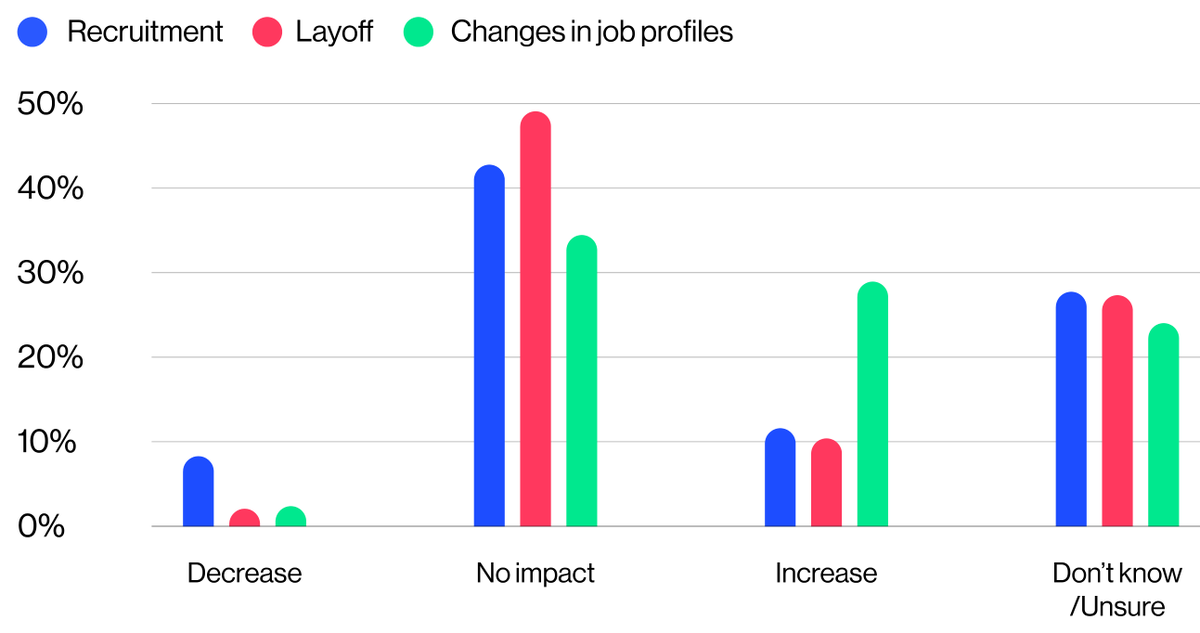
A possible destruction of jobs is one of the greatest policy concerns as AI takes hold in the economy. However, few of the respondents to our survey had experienced noticeable changes in productivity or employment following AI adoption (Figure 2.1). Indeed, more respondents had experienced an increase in recruitment than a decline. This aligns with other surveys covering Germany, the UK, the US and Australia (Yotzov et al 2026) and the European Union (Ferrando et al., 2026).
Figure 2.1. Shares of Respondents Reporting on the Impact of AI on Labor Markets
Source: PECC State of the Region Survey 2026
At the same time, a large majority of respondents said that productivity has increased following AI adoption. This is encouraging since a combination of productivity growth and stable employment implies sustainable expansion. However, while it is true that AI adopters on average are more productive than non-adopters, the difference is explained by superior human and organizational capital as well as pre-existing digital capabilities (Acemoglu et al., 2023, Calvino and Fontanelli, 2026; Calvino et al., 2026). In other words, the most productive firms are the first to adopt AI.
The productivity effect of AI use also depends on whether firms make or buy AI applications. A positive AI productivity relationship holds primarily for firms that develop AI in-house. In Chinese Taipei, for example, firms in the electronics industry that hold AI-related patents are more productive than comparable firms (Yang, 2022). The benefits from in-house developed AI stem from the flexibility to tailor the application to own needs and to continuously adjust to customer and supplier interfaces. This effect may, however, be temporary before AI applications become standardized and interoperable, like what happened when automation software gained widespread adoption (Hoffreumon et al., 2024).
The hitherto timid productivity impact of AI is not unprecedented in history. AI is considered a general-purpose technology, which means that it i) is used in most economic sectors, ii) it keeps getting better over time, and iii) it spurs innovation (Agrawal et al., 2019; Brynjolfsson et al., 2021; McElheran et al. 2025). Like other major technology shifts in the past, reaping the full benefit of AI requires complementary investment in human and organizational capital, which takes time. Sometimes such investments need to be made not only in the AI-adopting enterprise, but also by its suppliers and customers. Furthermore, economy-wide investment in skills, economic and institutional infrastructure needs to be made. During the transition period, productivity may well decline, before it bottoms out and embarks on a sustained upward path.
While most firms occasionally use AI, much fewer actually invest in it. When asked about the future, however, respondents to surveys say they plan to invest more in AI (e.g., Yotzov et al., 2026). This more optimistic view of future benefits could be based on positive experience with AI at work. Furthermore, randomized controlled trials demonstrate measurable productivity gains for individual workers performing specific tasks. In these trials, participants were assigned either to an AI-assisted treatment group or an unassisted control group performing identical tasks. Table 2.1 summarizes the findings from these experimental studies.
Table 2.1. Field experiments with AI
| Author | Setup | Result compared to control group | Note |
|---|
| Peng et al. (2023) |
Software developers with and without access to GitHub Copilot |
Completed coding tasks 55% faster. |
|
| Cui et al. (2026) |
Software developers doing coding at Microsoft, Accenture and one anonymous company. |
Completed coding 26% faster. |
Experiments run by the companies |
| Noy and Zhang (2026) |
Professionals completed writing tasks with or without access to ChatGPT |
Completed writing tasks 40% faster and with 18% better quality. |
|
| Dell’Acqua et al. (2026) |
Boston Consulting Group (BCG) consultants performing standardized tasks with and without access to ChatGPT4 |
Completed 12% more tasks at 25% faster within the competency of GPT-4, but 19 percentage point less likely to find the right solution outside its competency. |
Experiment in collaboration with BCG |
| Choi et al. (2024) |
Law students complete legal tasks with or without access to GPT-4 |
Completed the tasks 12-32% faster with no reduction in quality. |
|
| Brynjolfsson et al. (2025) |
AI assistant in customer services |
Increased issues resolved per hour by 15% |
A natural experiment with staggered introduction of AI assistants. |
All the experiments included in Table 2.1 found that AI improved productivity the most among the lesser skilled or experienced workers, bringing them up to speed with more experienced colleagues, contrary to the belief that AI benefits skilled workers the most. Who benefits in the end is, however, a complex question which may have different answers depending on the perspective one takes. It is for instance possible that AI support rapidly closes the gap between experienced and inexperienced workers in a specific task but still shifts labor demand towards more skills-intensive jobs in the aggregate (OECD 2026c).
Although there is scant evidence that AI has boosted productivity, the expectation that AI adoption stimulates firm growth is on firmer ground. Furthermore, AI appears to have the most substantial growth impact on large firms, at least in the US (Babina et al, 2024) or China (Liu, 2024), suggesting that AI adoption may be associated with market concentration in a broad set of sectors and economies.
What helps and hinders the adoption of AI
The question of what helps or hinders AI adoption typically revolves around the presence of or the absence of access to talent, fast and reliable broadband connections, credit – notably venture capital - and relevant data and compute resources. Thus, what helps and hinders AI adoption is two sides of the same coin.
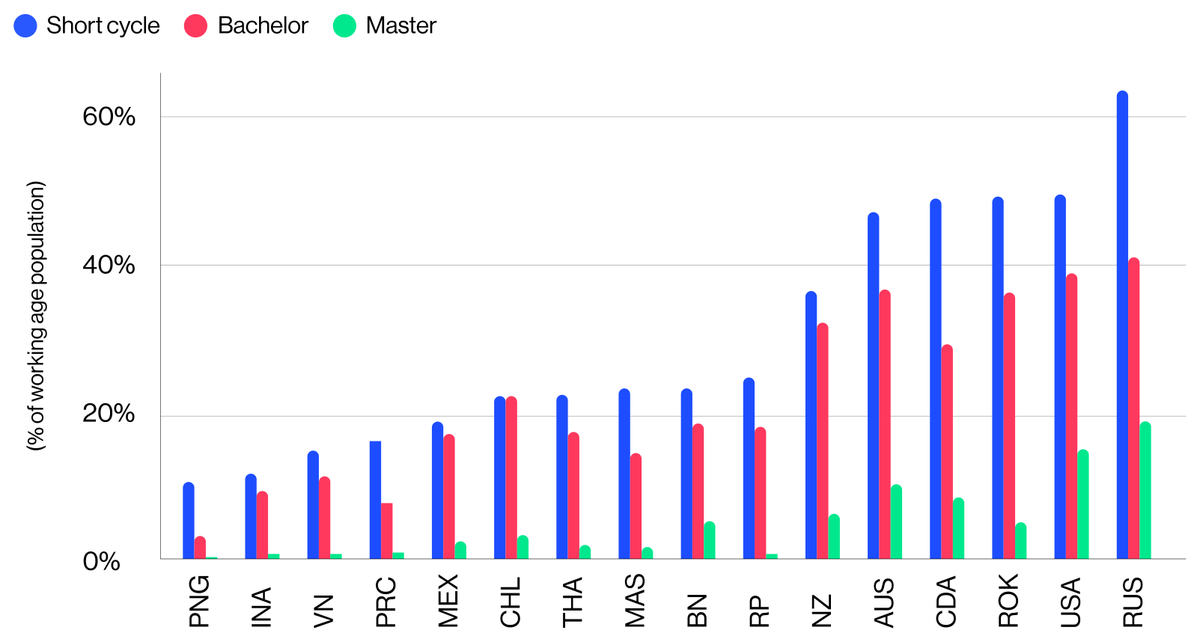
Enterprise surveys consistently show that access to skills and talent tops the list of complementary assets required for AI adoption, just as their absence remains the primary impediment cited by firms (See Chapter 1). While enterprises engaging in AI development typically require at least a bachelor's degree, AI adoption is somewhat less skills intensive. Nevertheless short-cycle tertiary education (typically two-year, practice-based, and occupation-specific programs) appears to be a minimum also for adoption. Figure 2.2 reports the share of the working-age population across APEC economies holding master's, bachelor's, and short-cycle tertiary credentials. The distribution suggests that formal education levels remain a binding constraint on widespread AI adoption across several member economies, posing an even steeper barrier to domestic AI development.
Figure 2.2. Share of working age population with tertiary education, APEC economies, latest year available
Source: World Development Indicators
While the general level of education is essential for growth and innovation, specific technical AI skills are crucial for AI adoption (OECD 2026c). Figure 2.3 shows the AI engineering skills penetration factor for selected economies.
Figure 2.3. AI skills penetration, selected economies
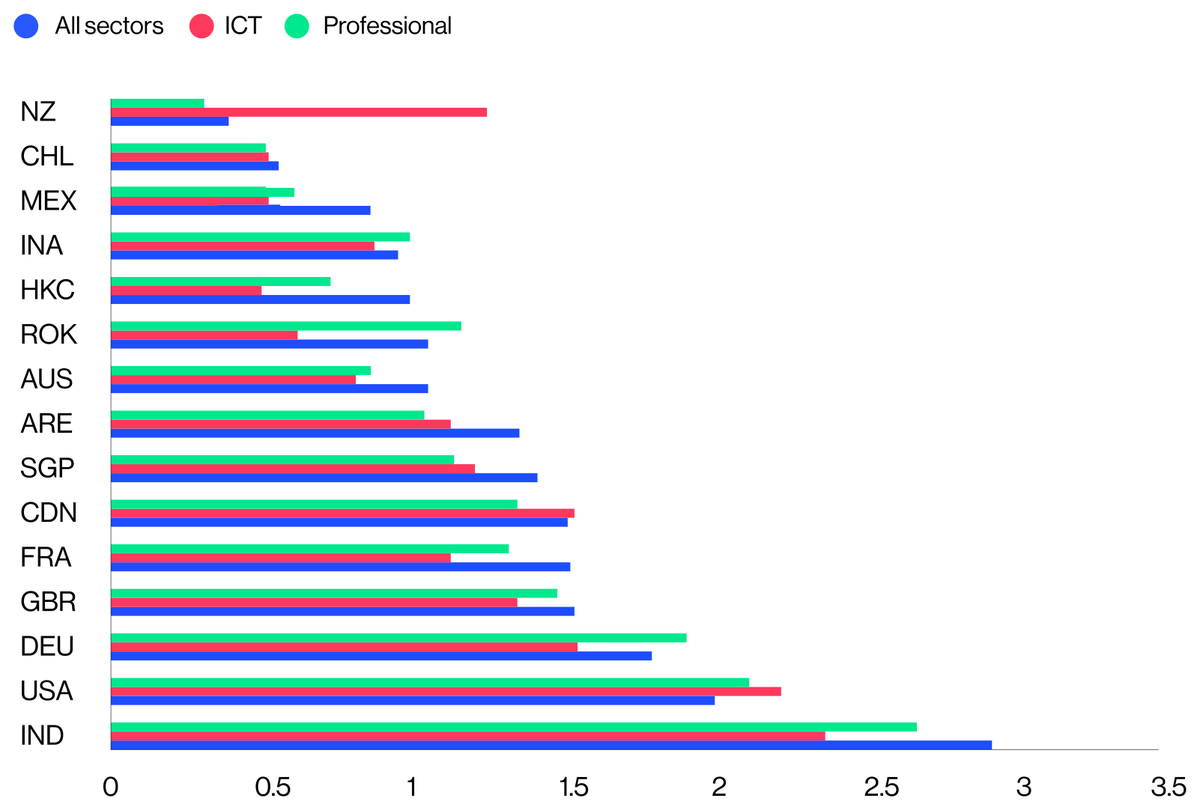
Note: The graph shows AI skills penetration, defined as the share of Linkedin profiles from each economy that mention at least two AI skills. The source reports results for broad occupations and the average for each economy. A limitation of this source is that it includes only economies in which Linkedin is widely used and Linkedin profiles are not representative of the labor force at large. The data cover the period 2021 to 2025.
Source: OECD AI Observatory
India’s performance on the skills metrics is remarkable. Although not representative for the population at large, it shows that India has a critical mass of AI competencies from which it leverages its pre-existing comparative advantage in ICT services.6 Among APEC economies, the US, Canada and Singapore appear to be well endowed with AI skills, while New Zealand seems to boast AI skills more narrowly in the ICT sectors.
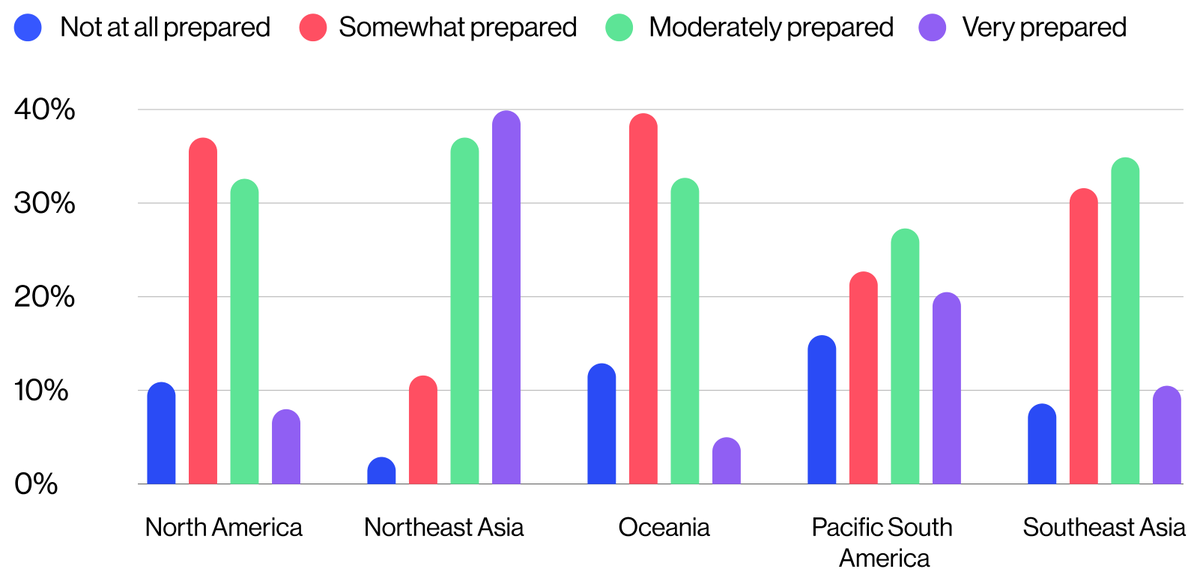
The second major factor that helps or hinders AI adoption is connectivity. Figure 2.4 shows the number of fixed broadband subscriptions per 100 inhabitants for APEC economies together with the infrastructure pillar of the IMF/World Bank AI Preparedness Index. The latter contains 11 measures, capturing a broad set of infrastructure-related indicators. It resonates with our survey question on digital infrastructure preparedness where respondents say that only Northeast Asia is very well prepared for AI as far as infrastructure is concerned (Figure 2.5)
Figure 2.4. Fixed broadband per 100 inhabitants and the AI Preparedness Index 2023
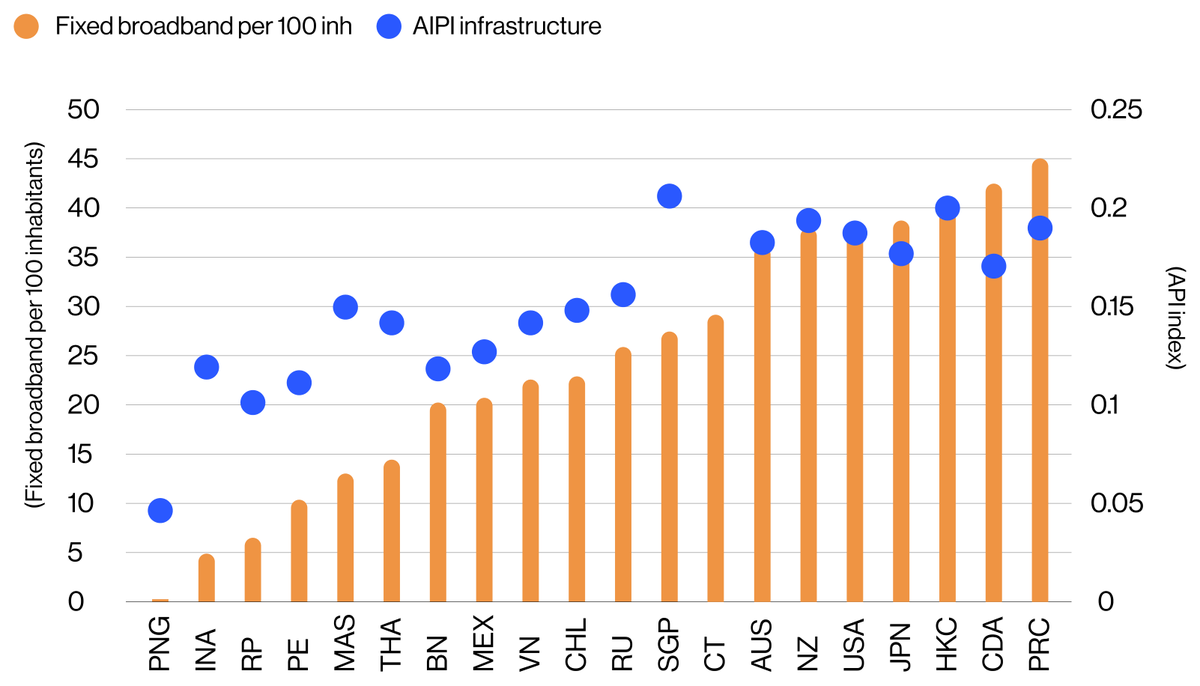
Note: AIPI refers to the infrastructure pillar of the AI preparedness index.
Sources: ITU, APEC and the IMF
Figure 2.5 Levels of Preparedness - Digital Infrastructure, by Subregion
Source: PECC State of the Region Survey 2026
Closely linked to digital infrastructure is access to relevant, high-quality data, which spans three interconnected layers. The first is a firm’s internal operational capacity to integrate and leverage proprietary data generated from customer interactions, supplier linkages, enterprise systems, and IoT sensors monitoring operations. The second layer is external connectivity infrastructure including access to affordable, resilient, low-latency broadband that enables seamless cloud adoption and cross-application interoperability. The third is the regulatory environment, particularly legal frictions such as strict purpose limitation rules that penalize or prohibit repurposing operational data for model training and fine-tuning.
In an open regional economy, these domestic layers intersect with cross-border constraints. Trading firms and multinational enterprises must routinely transfer operational data across jurisdictions to coordinate distributed supply chains. Moreover, because frontier AI training and high-performance cloud clusters are unavailable in many domestic markets, enterprises often rely on offshore compute infrastructure. These cross-border workflows face growing friction from data localization mandates and fragmented, conflicting jurisdictional rules—impediments that have intensified markedly in recent years.7
The link between policy restrictions on data flows and AI adoption is not linear. While privacy frameworks like the EU’s General Data Protection Regulation (GDPR) aim to protect users, evidence suggests they often inadvertently favor tech incumbents, who have the massive datasets needed to train competitive models (e.g., Johnson et al., 2023). In addition, stringent data rules tend to stifle AI start-ups that lack those deep data reserves. At the same time, an unregulated environment brings its own risks. Without clear rules, widespread adoption stalls due to a lack of public trust and legal certainty. For instance, almost 60% of the respondents to the survey presented in Chapter 1 say that regulation is a moderately or very important impediment to AI adoption. Furthermore, the second most important impediment to AI use in recent European surveys was lack of clarity about legal consequences. Ultimately, the most effective policy environment ensures safety and trust without burdening firms with excessive compliance costs (Chen et al., 2024; OECD and WTO, 2025).8
The survey results discussed above and in Chapter 1 identified access to finance as an important driver for AI adoption. It is especially important for start-ups that develop AI. Since AI-related assets are intangible and cannot readily be collateralized, venture capital is an important enabler of AI development and adoption, particularly in small firms and startups (OECD, 2026b).
For large, established firms, integrating AI into legacy systems remains a core adoption bottleneck. The causes include institutional inertia, regulatory and software interoperability gaps, and the need to invest in workforce skills and organizational change. Over time, emerging technical and regulatory standards will bridge some of these gaps. For now, however, standards that ensure interoperability between different components and ecosystems have yet to be developed. Nevertheless, there are areas where standards form the basic infrastructure that underpins innovation and adoption of AI. Examples are international standards establishing a common terminology and conceptual framework for AI (e.g., ISO/IEC 22989:2022), AI management and AI-related risk management (ISO/IEC 42001:2023 and ISO/IEC 23894) and not least benchmarks for cybersecurity, privacy, and information security management (the ISO/IEC 27000 family).
One of the most important standards in the digital economy is ISO/IEC 27001:2022 on “Information security, cyber security and privacy protection - Information security systems - requirements”. Together with ISO/IEC 27701:2025 on privacy controls, it underpins privacy and cyber security legislation and regulation in many economies. Table 2.2 reports the number of ISO 27001 certificates and sites in force in APEC economies in 2024.
Table 2.2. Number of ISO 27001 certificates and sites by economy, 2024
| Economy | Certificates | Sites | Economy | Certificates | Sites |
|---|
| Australia |
2217 |
7387 |
New Zealand |
154 |
385 |
| Brunei Darussalam |
2 |
9 |
Peru |
193 |
385 |
| Canda |
354 |
935 |
The Philippines |
155 |
479 |
| Chile |
134 |
260 |
Papua New Guinea |
7 |
12 |
| China |
33359 |
62245 |
Russia |
53 |
120 |
| Hong Kong, China |
214 |
467 |
Singapore |
689 |
120 |
| Indonesia |
1339 |
1970 |
Thailand |
497 |
1308 |
| Japan |
6644 |
12213 |
Chinese Taipei |
1943 |
3236 |
| Republic of Korea |
918 |
1531 |
United States of America |
4260 |
7831 |
| Mexico |
475 |
810 |
Vietnam |
430 |
787 |
| Malaysia |
677 |
947 |
|
|
|
Source: ISO
The smaller economies tend to have fewer certificates, as one would expect. Large economies such as Canada and Russia have relatively few, while China stands out as having more certificates and sites than all other APEC economies combined. A possible explanation is firms’ ambition to signal quality and reliability in international markets when local standards are lacking or differ from international standards while mutual recognition is not in place.
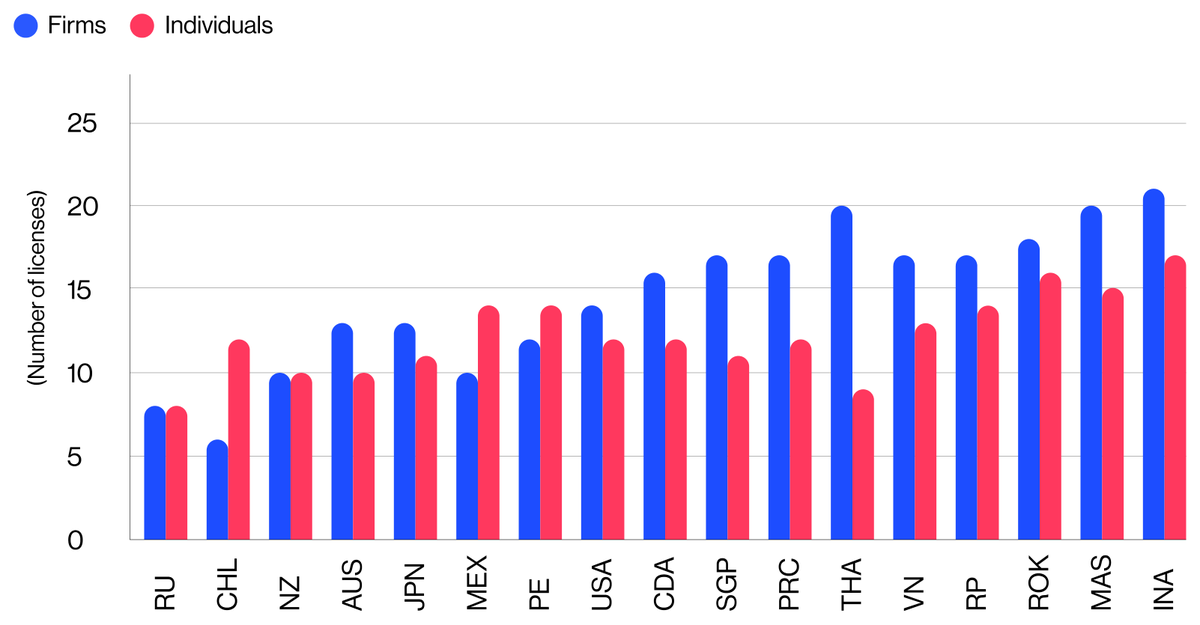
Competitive pressure is an essential driver of both technological innovation and the diffusion of AI. While professional and business services trail only the ICT sector in AI adoption, they are simultaneously among the most heavily licensed activities in the economy. Although licensing aims to address market failures by reducing information costs and reinforcing consumer trust, they frequently stifle dynamic competition. By restricting entry, licensing can compress market supply, elevate consumer prices, and weaken incentives for firms to unbundle tasks and invest in labor-saving AI systems (Kleiner, 2000, 2006; Hadfield, 2022). Figure 2.6 maps the prevalence of these requirements across key sectors (finance, professional services, and ICT), distinguishing between licensing applied at the firm level versus those imposed on individual practitioners.
Figure 2.6. Number of licenses required in selected sectors, APEC, 2025
Source: OECD Services Trade Restrictiveness Index regulatory database.
Finally, path dependence appears to be driving AI adoption, i.e., adoption begets adoption. For instance, a survey by the European Central Bank (ECB) found that intensive AI users planned to invest substantially more in AI going forward than non-users. They interpreted this as a feedback loop where early adopters continue to integrate AI into their operations, widening the gap between intensive and occasional users (Ferrando et al., 2026).
Sectoral impact of AI adoption
While survey-based reports differ widely on the overall AI adoption rate, they agree on the ranking of AI use by economic sector and occupation. For illustration, the sector ranking from Eurostat’s survey in 2025 is depicted in Figure 2.7.
Figure 2.7. AI use in enterprises, by broad sector, EU27, 2025
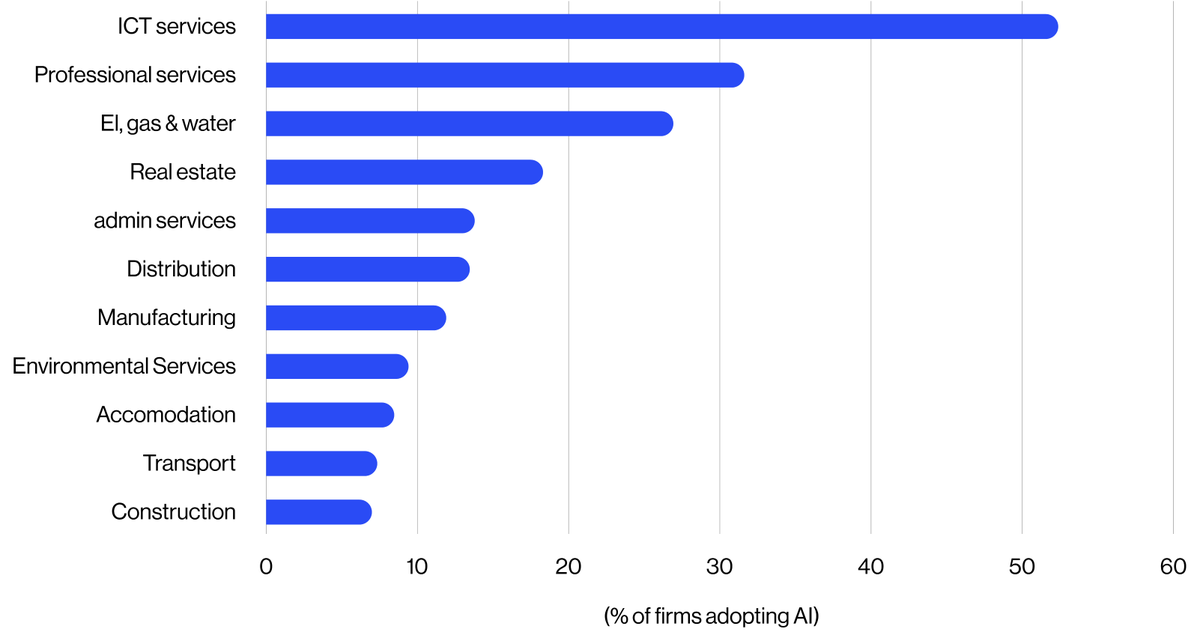
Note: Financial services are among the most intensive AI adopters in the US (30% of firms) but not included in Eurstat’s survey.
Source: Eurostat
ICT sectors come out on top in all major surveys on enterprise AI use. From a job’s perspective, ICT specialists, engineers and other professionals are the occupations where AI-related abilities are most frequently sought (e.g., HAI AI Index, report 2026).
In manufacturing, enterprise adoption remains modest due to the physical and systemic complexity of modern production (Arinez et al., 2020; Peres et al., 2020). While discrete, point-solution applications, such as computer-vision defect detection, are common, full systems-level integration across entire production lines remains scarce. The primary bottlenecks stem from operational interdependencies, fragmented machine telemetry, and a persistent shortage of specialized integration skills. Consequently, adoption within manufacturing is heavily concentrated among R&D- and knowledge-intensive producers (Kinkel, 2022). Underscoring these organizational challenges, industrial AI deployment requires substantial restructuring, driving a sharp rise in demand for managerial coordination and workflow-redesign skills (Alekseeva et al., 2026).9
Among the fastest growing AI-adopters are retail and wholesale services. This sector was at the frontier of ICT adoption and saw substantial productivity and market concentration effects from standard software. The benefits of early adoption of AI therefore did not outweigh the costs. However, with substantially better AI applications both for customer relations and supply chain management in the face of increasingly volatile markets, AI adoption is gathering pace.
The sectors where AI is less frequently adopted are construction, accommodation and transport. These sectors are also the ones where small; old, family or manager-owned firms are the most common and sector-specific dynamics closely track the firm-level governance and ownership constraints identified earlier.
Although the least AI intensive so far, construction may be one of the sectors with the largest potential gains from AI. Thus, systems-wide AI-enabled Building Information Modelling (BIM) shows great promise for substantially reducing re-work, delays and overspending in building projects (Disney et al., 2023). However, like the manufacturing sector, complexity delays systems-wide AI adoption. Specifically, lack of interoperable processes, a plethora of different standards and building codes, lack of machine-readable documents and not least occupational licensing, have held back its adoption. China, Singapore and Malaysia have, however, made significant strides towards successful adoption of the technology by coupling public procurement mandates with standardized platforms and BIM roadmaps (Yang and Xie, 2026).10
AI, international trade and global value chains
The digital transformation of the economy, enhanced by AI, reduces trade costs substantially, as illustrated by the case study reported in Box 1.1. Thus, search costs - be it for suppliers, customers or inputs - are lower; transport costs can be negligible for products transmitted over digital networks; and products in transit can be tracked, reducing uncertainty about lead time and thereby lowering inventory costs. For digital products, the cost of replication can be exceedingly low once a master file has been developed – often at considerable development cost (Goldfarb and Tucker, 2019). In short, AI reduces the costs of trade and distributed production along global value chains. WTO estimates AI could boost trade by between 35 and 40% by 2040 (WTO, 2025).
AI not only affects trade costs. It also has the potential to change patterns of comparative advantage and competitiveness. Thus, AI feeds on data which, when combined with connectivity, constitute a source of comparative advantage for data-intensive goods and services. Like other intangible assets, data are non-rival in use. Furthermore, the marginal cost of adding another use or user is close to zero, making data and other intangible assets hugely scalable. They can be deployed to multiple functions in different locations at the same time, adding economies of scope to the features of AI-enabled trade. Examples of companies that benefit from data-driven economies of scale and scope are digital platforms providing the infrastructure for trade as well as offering their own services.
However, data and intangible assets in general are also partly or fully excludable, limiting the benefits and positive externalities to the entities that have access to them. These are often the ones that made the intangible investment in the first place. Thus, multinational enterprises or non-equity business partnerships are at a substantial advantage when deploying intangible assets to manage and optimize their value chains.
AI forms global supply chains of its own, comprising compute (hardware such as GPUs and servers), infrastructure (e.g., data centers and cloud services), data tools (e.g., data, labeling and reinforcement learning), models and applications (e.g., integrate AI models into consumer products). As indicated in Figure 2.8, economies are highly specialized in these supply chain layers. It shows the value by layer produced in each of the 15 largest AI producing economies in the world.11
Figure 2.8. AI supply chain layer composition
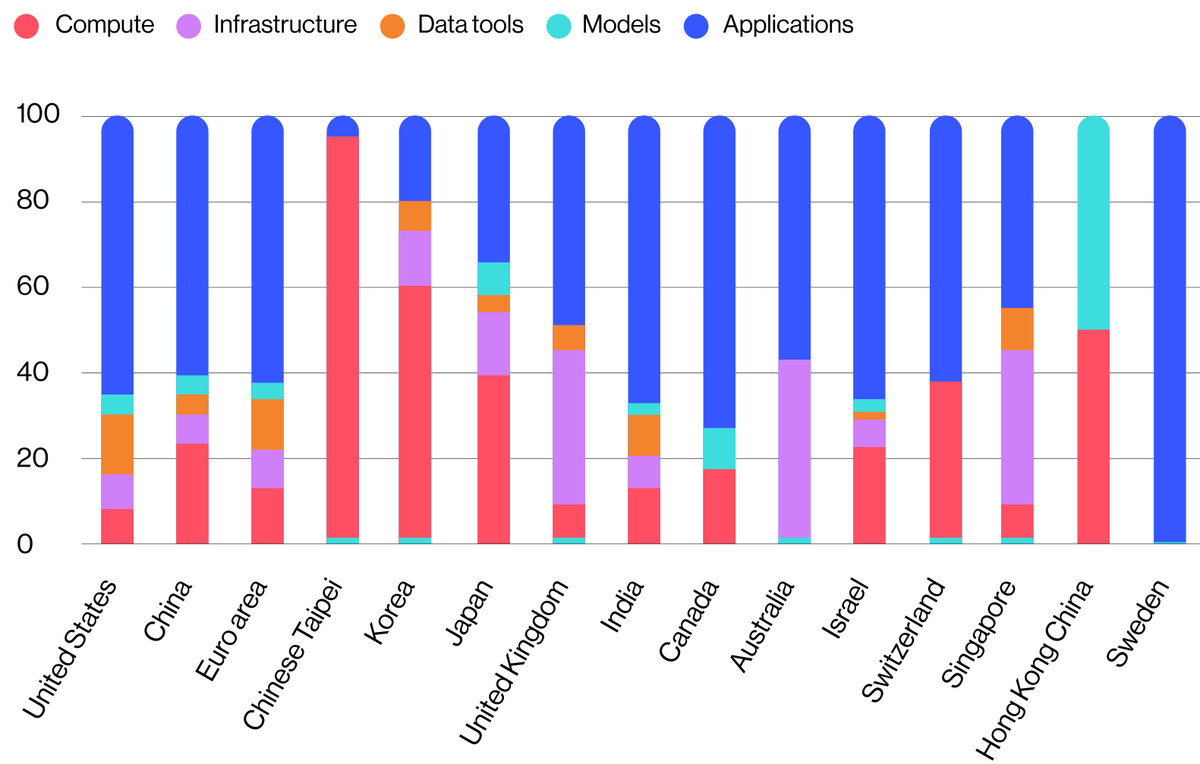
Note: The chart ranks economies according to total value produced by AI firms. The Euro Area is considered one economy.
Source: Rishabh and Shreeti, 2026
Asia Pacific figures prominently on the chart. Large economies (USA, China, The Euro Area, Japan and India) have relatively diversified supply chains, while Chinese Taipei and Sweden are almost completely specialized in compute and applications respectively.
To summarize, the relationship between AI and international trade is mutually reinforcing: AI streamlines cross-border supply chains and reduces transaction costs, while trade and investment channels provide firms with the data, compute, and tools needed to adopt AI. Nonetheless, as discussed above, policy barriers such as data localization and restrictions on cross-border transfer erect barriers to entry and reduce the opportunities for start-ups in smaller markets to scale and to train their own AI applications.
Legal and regulatory landscape
The Asia-Pacific has crossed a threshold in AI governance, and it happened faster than most accounts of the region acknowledge. Between January 2025 and September 2026, six member economies brought dedicated AI framework laws into operation, and a second group moved to published drafts. Nearly every member economy now has a strategy, and almost all of those strategies promise skills, ethics and measurable targets. What most member economies do not yet have is the machinery to deliver any of it: the impact assessments, the standards and certification arrangements, the technical bodies able to evaluate a system before it is deployed. This section argues that the region’s binding constraint has shifted. It is no longer a shortage of policy. It is a shortage of capacity to administer the policy already made, and that is where regional cooperation can do the most good.
The preceding sections asked how widely AI has been adopted and what it has delivered. This section asks under what rules. The two questions are connected. Several of the impediments identified above, data localization requirements, professional licensing regimes, the treatment of automated decisions, are not market features. They are policy instruments, and they can be changed.
No single source describes this landscape well, so the account below combines four. The instruments themselves come first, because the period has been unusually active and the comparative literature has not caught up. Collective commitments are taken from APEC’s own documents, principally the Internet and Digital Economy Roadmap (APEC, 2017) and the AI Initiative discussed below (APEC, 2025). Two running inventories supply individual measures: the OECD AI Policy Observatory (OECD, 2026b) for AI-specific initiatives, and the UNCTAD Global Cyberlaw Tracker (UNCTAD, 2026) for the data protection and electronic transactions law that in most member economies carries the obligations actually bearing on AI. For comparison across economies the section uses the AGILE Index (Zeng et al., 2025), which scores economies on AI development, governance environment, governance instruments and governance effectiveness. It is preferred to readiness indices, which measure the capacity to adopt AI rather than the arrangements governing it, and its coverage spans income levels rather than only the industrialized members of the region. Where sources disagree, the instrument governs.
From Strategies to Statutes
Until recently, AI policy in most of the Asia-Pacific meant strategies, principles and voluntary guidance sitting alongside general law. That description no longer holds. Between January 2025 and September 2026, six member economies moved dedicated AI instruments through adoption and into force, and a second group published draft legislation (Figure 2.9). This is the most significant change in the regional landscape since the previous edition of this report.
Korea’s Framework Act was promulgated in January 2025 and took effect a year later alongside its Enforcement Decree.12 It imposes obligations on high-impact AI in health care, employment, finance, education and public safety, requires disclosure when users are dealing with a generative system, requires generated content to be labeled, and reaches operators outside the economy whose systems affect users within it. Fines reach KRW 30 million for specified breaches, but enforcement carries a grace period of at least a year while implementing guidance is written.
Japan first legislated on AI in 2025, and the Act took full effect that September. The Cabinet adopted the AI Basic Plan under it in December, and an AI Strategy Headquarters now sits under the Prime Minister.13 The Act promotes rather than restricts. It sets principles, provides for the Plan and asks for cooperation rather than imposing penalties, leaving detailed requirements to ministerial guidelines and sectoral law. Where a business does not comply, the remedy is investigation and public identification rather than a fine. Its priorities include adoption in government services and enhanced domestic development capability, trustworthiness, and adjustment to changes in employment and industry.
Chinese Taipei’s AI Basic Act passed in December 2025 and came into force the following month.14 It is short. It codifies principles, sustainability and well-being, human autonomy, privacy, security, transparency, fairness and accountability and calls for a risk classification framework, leaving detailed obligations to sectoral regulators.
Vietnam moved from a general framework to a dedicated statute inside a year. AI provisions first appeared in the Law on Digital Technology Industry in mid-2025; these were superseded by the Law on Artificial Intelligence, passed in December 2025 and in force from March 2026.15 The Law classifies systems by risk, applies to domestic and foreign entities alike, and gives existing systems staged transition periods, with longer periods in health care, education and finance.
Peru’s 2023 framework law acquired operative content when its implementing regulation, published in September 2025, took effect in January 2026.16 Transparency obligations are phased by sector. Health, education, justice, security, economy and finance come first, followed by transport, commerce and labor, then production, agriculture, energy and mining. The sequencing is revealing: the sectors judged to matter most are given the least time to prepare.
Russia is the most recent addition: a framework law on supporting the development of AI technologies was adopted in July 2026 and took effect on 1 September 2026.17 It brings large foundation models within a statutory framework, distinguishes categories of domestically developed models, and addresses the use of protected material in training and the rights attaching to generated outputs. It sits on top of a strategy first issued in 2019 and updated in 2024, and a voluntary ethics code from 2021.
China has taken a different route, building binding administrative measures for specific technologies and services rather than one comprehensive statute.18 Measures now cover algorithmic recommendation, deep synthesis, generative AI services and the labeling of AI-generated content, the last reinforced by a mandatory technical standard. Alongside them, the State Council’s Opinions on the “AI Plus” Initiative set an integration agenda across science and technology, industry, consumption, livelihoods, governance and international cooperation, with penetration milestones for key sectors. Work towards a comprehensive AI law has been under way since 2023, and the State Council’s 2026 legislative work plan, published in May, calls for that legislation to be accelerated, alongside legislative improvements covering data, computing power, algorithms, data property rights, cybersecurity and supply-chain security.19 Governance and adoption advance together rather than in sequence.
The remaining member economies rely for now on strategies, principles and sectoral guidance alongside general law. Singapore has the most developed assurance approach, extending its model governance framework to generative AI, maintaining a testing toolkit and issuing sectoral guidance for finance, health and education.20 Australia adopted a National AI Plan in December 2025 that relies on technology-neutral law and a voluntary safety standard of ten guardrails.21 The United States is structurally distinct from every other member economy. Federal policy runs through executive action and planning documents rather than statute, and the December 2025 executive order sets out to constrain state AI laws rather than to add federal ones, establishing a litigation task force for the purpose. Binding AI law in the United States is therefore made principally at state level, where 109 AI statutes had been enacted by mid-2026, including the Colorado AI Act and California’s frontier model transparency statute.22/2323 Malaysia has set up a dedicated AI office and committed budget for domestic AI compute. Indonesia and Thailand have economy-level strategies with binding instruments at various stages of preparation, while the Philippines relies on its strategy roadmap.
Elsewhere in the region the position varies widely. Chile has a risk-based bill before its Senate, sorting uses into four categories from unacceptable to no evident risk, on which the executive proposed a substitute framework in May 2026 oriented to innovation, productivity and competitiveness. New Zealand published its first AI strategy in July 2025 and stated expressly that it does not intend a standalone AI statute, relying instead on technology-neutral law and voluntary guidance for business, with a separate framework governing the public service. Hong Kong, China issued a generative AI technical and application guideline in April 2025, updated in December, built on five pillars covering personal data privacy, intellectual property, crime prevention, reliability and system security, alongside binding circulars from its financial regulators. Brunei Darussalam released an AI governance and ethics guide in 2025 and gazetted a personal data protection order in the same year. Papua New Guinea has a draft sovereign digital transformation and AI strategy in public consultation which proposes a National AI Act and a data governance statute. Mexico has AI bills before its Congress but no enacted instrument.24
The drafting cohort has grown since. Thailand’s Electronic Transactions Development Agency released draft AI legislation on 9 July 2026, risk-based in structure, with consultation closing in August. Indonesia has a draft Presidential Regulation setting risk categories and labeling requirements, alongside new rules on intellectual property in digital form. Malaysia is preparing an AI Governance Bill through its National AI Office.25 Movement is not uniform, and in one case has run the other way: Canada’s Artificial Intelligence and Data Act lapsed when the parliamentary session ended in January 2025 and has not been reintroduced, leaving AI there to the voluntary code, privacy law and rules on the government’s own use of AI.26 Taken together, the direction is clear enough. On present trajectories the number of member economies with binding AI instruments will roughly double within the period covered by the APEC AI Initiative.
Table 2.3. Principal AI-specific policy instruments at regional and economy level, as of September 2026
| Author | Setup | Year | Note |
|---|
| All member economies |
APEC Artificial Intelligence Initiative (2026–2030); APEC Internet and Digital Economy Roadmap |
2025; 2017 |
Leaders-level; voluntary, advanced through APEC fora |
| Australia |
National AI Plan; Voluntary AI Safety Standard (ten guardrails) |
2024–25 |
Voluntary; general law applies |
| Brunei Darussalam |
AI Governance and Ethics Guide |
2025 |
Voluntary guidance |
| Canada |
Voluntary Code of Conduct on Advanced Generative AI Systems; Directive on Automated Decision-Making |
2019–23 |
Voluntary; directive binds federal institutions; no comprehensive bill before Parliament |
| Chile |
National AI Policy; bill regulating artificial intelligence systems, before the Senat |
2021; bill 2024– |
Policy adopted; risk-based bill not yet in force |
| China |
State Council Opinions on the “AI Plus” Initiative; measures on algorithmic recommendation, deep synthesis, generative AI services and labeling of AI-generated content; comprehensive AI legislation on the 2026 legislative work plan |
2022–26 |
Policy program; binding administrative measures and mandatory labeling standard; comprehensive law in preparation |
| Hong Kong, China |
Generative AI Technical and Application Guideline; Ethical AI Framework for government use |
2024–26 |
Voluntary guidance; supervisory expectations in regulated sectors |
| Indonesia |
National AI Strategy (Stranas KA); draft Presidential Regulation on AI |
2020; draft 2026 |
Strategy; binding instrument in draft |
| Japan |
Act on Promotion of Research, Development and Utilization of AI-Related Technologies; AI Basic Plan |
2025 |
Binding statute without penalties; plan and guidelines |
| Korea |
Framework Act on the Development of AI and Establishment of a Foundation for Trustworthiness, with Enforcement Decree |
2024–25 ; in force 2026 |
Binding; obligations for high-impact and generative AI |
| Malaysia |
National AI Roadmap (AI-RMAP); National Guidelines on AI Governance and Ethics; AI Governance Bill in preparation |
2022–26 |
Voluntary guidelines; binding instrument in preparation |
| Mexico |
No dedicated AI instrument adopted; AI bills before the Congress |
— |
Bills under consideration |
| New Zealand |
Strategy for Artificial Intelligence; Responsible AI Guidance for Businesses; Public Service AI Framework |
2025 |
Voluntary; no standalone AI statute intended |
| Papua New Guinea |
Draft National Sovereign Digital Transformation and AI Strategy, proposing a National AI Act |
draft 2026 |
Strategy in public consultation |
| Peru |
Law 31814 promoting the use of AI, with implementing regulation (Supreme Decree 115-2025-PCM) |
2023; in force 2026 |
Binding; phased sectoral obligations |
| Philippines |
National AI Strategy Roadmap 2.0 |
2024 |
Strategy |
| Russia |
Federal law on supporting the development of AI technologies; National AI Strategy to 2030; Code of Ethics in the Field of AI |
2019–26 ; in force 2026 |
Binding promotional framework law; strategy and voluntary code |
| Singapore |
National AI Strategy 2.0; Model AI Governance Framework, extended to generative AI; AI Verify testing toolkit |
2019–25 |
Strategy and voluntary framework; assurance tooling |
| Chinese Taipei |
AI Basic Act |
2025; in force 2026 |
Binding framework; principles, with risk classification to be developed |
| Thailand |
National AI Strategy and Action Plan; draft AI legislation (ETDA, July 2026) |
2022; draft 2026 |
Guidance; risk-based bill in consultation |
| United States |
Executive Order 14365, Ensuring a National Policy Framework for Artificial Intelligence; America's AI Action Plan; state statutes including the Colorado AI Act |
2025–26 |
Federal policy through executive action; binding AI law made principally at state level |
| Vietnam |
Law on Artificial Intelligence |
2025; in force 2026 |
Binding; risk-based, with staged transition periods |
Note: The first row records instruments agreed collectively by all member economies; the remainder show the principal AI-specific instruments of each economy. Where an economy has several, the instrument in force with the strongest legal effect is listed first, followed by the strategy or guidance that frames it; instruments not yet in force are shown with their stage. General data protection, cybersecurity and intellectual property law is excluded even where it carries obligations bearing on AI, since it is not AI-specific. Years span first adoption to the most recent revision. The table is not exhaustive; most economies listed maintain further sectoral guidance alongside the instruments shown.
Source: APEC documents and the official instruments and government publications of the respective member economies.
Four Approaches, One Direction
These instruments fall into four approaches. The categories describe rather than rank. Each reflects an economy’s industrial structure, administrative tradition and position in AI supply chains.
- Comprehensive risk-based statutes, which sort systems by the severity of their potential effects and attach graduated obligations. Korea, Vietnam and, through its regulation, Peru. All three chose extended or phased transitions so that enterprises, and particularly MSMEs, have time to prepare.
- Promotion-first framework laws, which set principles, coordination bodies and planning cycles and leave substantive requirements to guidelines and sectoral regulation. Examples are Japan and Chinese Taipei.
- Layered administrative instruments, which regulate defined services as they mature and are paired with an explicit adoption program. Examples are China and Russia.
- Principles with sectoral guidance and assurance tooling, where no dedicated statute is yet in force and governance works through strategies, voluntary standards, testing frameworks and general law. This covers most other member economies — among them Singapore; Australia; New Zealand; Canada; Malaysia; Thailand; Indonesia; the Philippines; Brunei Darussalam; and Hong Kong, China — as well as the current federal posture of the United States.
Underneath the variety, the direction is the same. Every approach converges on the same handful of functions: tell users when content is generated or a decision is automated; impose more where systems touch health, employment, finance, education or public safety; assess risk before deployment; and name somebody responsible. The instruments differ in legal form and in sequencing far more than in what they actually ask of developers and deployers.
Wide Commitment, Thin Machinery
Four building blocks now appear across the region, and how far each has spread says more about institutional development than the presence or absence of a statute. The first is a published strategy. The second is a designated authority — a ministry, a council chaired at head-of-government level, a science and technology body or a dedicated office — which determines how fast guidance appears and how consistently it is applied. The third is standards and assurance, where the region has moved furthest towards practical interoperability: testing frameworks, model governance guidance, labeling standards and conformity arrangements are being built in several economies at once, and shared standards work gives a common vocabulary even where legal instruments differ. The fourth is data protection law, which in most member economies already carries the obligations on training data, automated decisions and personal information. Governance of AI is therefore wider than the AI instruments alone suggest.
Across the member economies for which evidence has been assembled, these four form a steep gradient.27 The strategy layer is effectively universal: all of them have published a strategy, and in every case it sets out specific measures or targets, addresses training and skills, and addresses ethical implications. After that the picture thins fast. Published principles appear in roughly three-quarters, a designated governance body and a comprehensive law or legislative process in about two-thirds, and data protection provisions bearing directly on AI in fewer than half. Impact assessment mechanisms, sector-specific AI rules, and standards or certification arrangements appear in around a third each. The gradient runs from declaration to administration.
Two features of that machinery are worth drawing out. The first is that the strategy layer is ageing. Of the member economies with recorded evidence, 13 adopted their foundational strategy before 2023, the earliest in 2017.28 This measures the founding document rather than all policy activity: several member economies, China among them, have since issued programmatic instruments that function as refreshes without being recorded as strategies, and the statutes described above are themselves evidence of continuing work. The point is not that policy has stood still, but that in most cases the architecture housing it has not been revisited as a whole. For several member economies, refreshing the strategy may matter more than adding another instrument. APEC can prompt this without prescribing content: the AI Initiative's annual progress reviews and voluntary readiness reviews offer a natural occasion for member economies to report when their foundational strategy was last revisited, and to compare how others have approached a refresh.
The second is the establishment of technical evaluation capacity as a distinct institutional form. Bodies created between 2017 and 2022 were mostly advisory: councils, committees, strategy conferences. Between late 2023 and 2024, five member economies established dedicated AI safety institutes, and a sixth followed with a related network in early 2025.29 These bodies differ in function rather than in rank. They exist to evaluate systems, develop testing methods and hold technical expertise inside government. Their clustering within little more than a year mirrors the legislative clustering, and the two are plainly connected: a statute that requires risk assessment presupposes an institution that can perform one.
Figure 2.9. Comprehensive AI framework laws entering into operation in APEC member economies, 2025–26
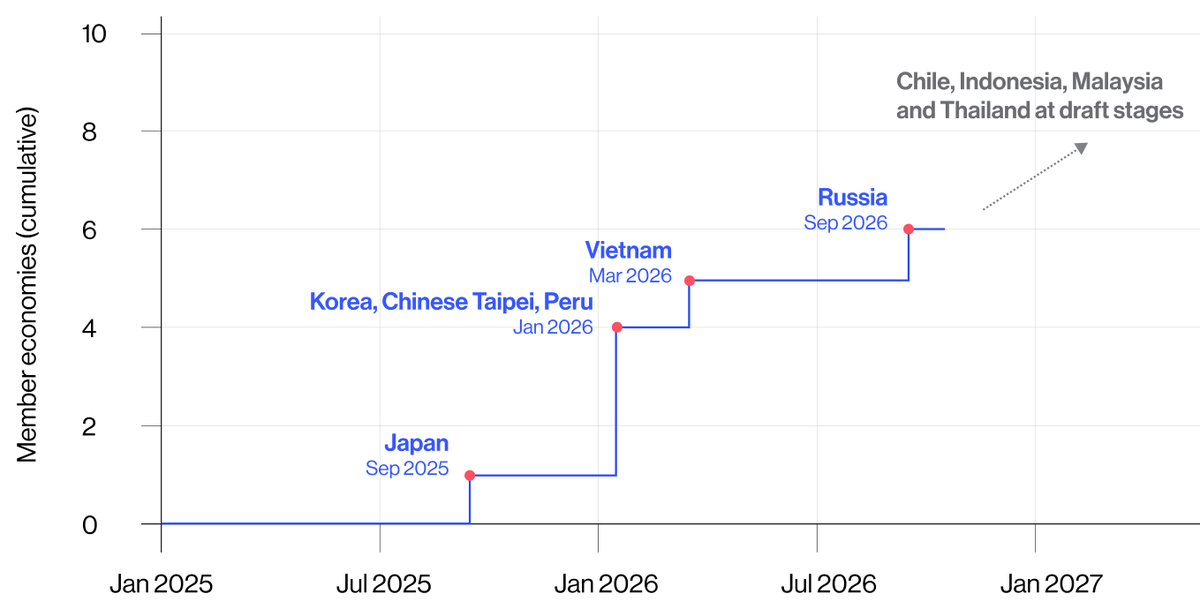
Note: Counts member economies in which a comprehensive AI framework law entered into operation between January 2025 and September 2026; for Peru, the date is that of the implementing regulation that made its 2023 framework law operative. Strategies, principles and voluntary guidance are excluded. Earlier AI-specific legislation is not shown, including the United States National AI Initiative Act (2020), Russia’s experimental legal regime for AI in Moscow (2020), and local AI regulations in Shanghai and Shenzhen (2022) alongside China’s binding economy-wide administrative measures. Economies shown as at draft stage have published draft legislation or have a bill before their legislature as of September 2026
Source: The official instruments and government publications of the respective member economies.
Three kinds of unevenness matter for the economic opportunities this chapter is concerned with. The first is implementation capacity. Adopting an instrument and running it are different jobs, and several statutes now in force still depend on subordinate regulations, technical guidance and risk classification frameworks that have not been written. For developing economies especially, the constraint is rarely a lack of policy intent. It is the specialized capacity to draft implementing rules, evaluate systems and supervise deployment. UNCTAD’s assessment of preparedness across 170 economies identifies infrastructure, data and skills as the leverage points that capacity rests on, and finds several developing economies, among them China and the Philippines, performing well above what their income levels would predict (UNCTAD, 2025).
The second is definitional divergence. Economies with risk-based approaches do not define risk categories the same way, and the thresholds for heightened obligations differ. For firms operating in several markets, and disproportionately for MSMEs with no compliance function, that raises the cost of entering more than one. It is consistent with the earlier finding that regulatory barriers to entry, such as occupational licensing requirements, correlate negatively with AI adoption (Figure 2.6). What a large firm absorbs as a compliance cost can keep a small one out.
The third is coverage. Comparative datasets reach economies unevenly, and the smaller and less industrialized member economies are the most likely to be missing from them. Their policy development is less visible in regional analysis than that of larger economies, which is reason enough to treat any composite ranking as a partial picture.
Where the Region Already Agrees
The region’s own framework was settled shortly before this report was prepared. In November 2025, APEC Economic Leaders endorsed the APEC Artificial Intelligence Initiative for 2026 to 2030 — the first leaders-level AI instrument adopted in this forum, and the first to which all 21 member economies are party.30 It sets three objectives: resilient economic growth through AI innovation and secure, accessible and reliable AI ecosystems; greater participation by member economies in AI transformation through cooperation and capacity building; and AI development supported by efficient energy use and resilient infrastructure investment. Three strategic goals follow, covering AI transformation within APEC, the building of AI capacities from public administration to consumers, and an investment ecosystem for AI infrastructure.
Three features matter for the argument here. It is framed in economic rather than safety or ethical terms: growth, productivity, MSME participation, workforce transition, infrastructure. That distinguishes it from the statements discussed below and places it squarely in the subject matter of this report. It is voluntary and flexible, and says so, acknowledging that member economies sit at different stages of development — consistent both with APEC practice and with the variety of regulatory approaches described above. And it is not merely declaratory: it is anchored to the Putrajaya Vision 2040, the Aotearoa Plan of Action and the Internet and Digital Economy Roadmap, advanced through existing fora with annual progress reviews to 2030, and open to the participation of the APEC Business Advisory Council and PECC.31
Its targeted actions track the constraints identified above almost point for point. Voluntary economy-level AI readiness and impact reviews address the visibility problem. Exchange of policy knowledge and comparative benchmarking address definitional divergence. Commitments on public sector capacity, including deploying AI in public services and upskilling the staff who run them, are the subject of the next section. And capacity building sits at the core, which is the constraint the evidence here most consistently identifies.
Member economies also take part in instruments convened elsewhere (Table 2.4). Participation there is partial and uneven, and measures the reach of each instrument into the region rather than the region’s own cooperation.32
Table 2.4. Participation of member economies in international AI governance instruments
| International instrument | Year | Member economies participating |
|---|
| Global Digital Compact |
2024 |
19 |
| UNESCO Recommendation on the Ethics of Artificial Intelligence |
2021 |
18 |
| Statement on Inclusive and Sustainable AI (AI Action Summit, Paris) |
2025 |
12 |
| The Bletchley Declaration |
2023 |
11 |
| Seoul Ministerial Statement on AI safety, innovation and inclusivity |
2024 |
11 |
Note: Counts are of the 21 member economies. The instruments shown address civilian applications of AI and fall within the economic scope of this report. Participation in intergovernmental instruments depends on membership of the convening organization, and participant rosters record entries at differing levels of aggregation; counts measure the reach of each instrument within the region, not the engagement of individual economies.
Source: participant rosters of the instruments listed; compilation as of 31 March 2026.
The widest reach belongs to instruments adopted through standing multilateral organizations: nineteen member economies are covered by the Global Digital Compact and eighteen took part in adopting the UNESCO Recommendation. Reach falls by about a third for statements issued through summit processes, which draw eleven or twelve. It falls again where what is asked is not assent to a text but the commitment of institutional resources: five member economies have built a dedicated technical body, and a sixth a related network. The contrast is instructive. Full participation across the membership has been reached not through any of these instruments but through the one negotiated inside the region, on terms its members set.
The gradient says the same thing as the domestic picture. What limits cooperation is not reluctance to endorse shared principles, which is close to universal. It is the capacity to act on them. Arrangements asking member economies to supply technical capability reach about a quarter of the membership; those asking only for agreement reach nearly all of it. That is why the Initiative’s emphasis on capacity building, rather than on more instrument-making, is the right one.
Four things worth doing
Four practical openings follow from the convergence described above. None requires harmonized legislation, and all sit inside the Initiative’s capacity-building goal.
- Recognize each other’s test results. Where member economies are building testing frameworks and conformity arrangements in parallel, mutual reliance on evaluation results cuts duplicated cost for firms and conserves regulatory capacity that is scarce everywhere.
- Keep building the shared technical vocabulary. Joint work in international standards is the least contentious route to interoperability, because it aligns definitions without asking any economy to adopt another’s legal model.
- Coordinate sandboxes and staged obligations. Several instruments in the region already provide for both. Designing them together would let smaller economies learn from larger ones without importing rules that do not fit their circumstances.
- Treat capacity building as the main event. Help with drafting implementing rules, with evaluation capability and with supervisory training goes at the binding constraint directly. More instruments do not.
The agenda this points to is interoperability of practice, not uniformity of law, which is what APEC has always been better at. Specific initiatives through which APEC could take these forward are set out in the policy implications at the end of this chapter.
AI transformation in health and education
We have chosen to give special attention to health and education for three reasons. First, they complement the sectors examined above: both are largely publicly provided, so their AI transformation is driven by government decisions rather than market signals and is largely invisible in firm-level adoption data. Second, both are labor-constrained across much of the region, which makes AI-assisted delivery economically consequential rather than merely convenient, and education is where the skills identified earlier as a leading driver of adoption are built. Third, both are public services with leader- and ministerial-level engagement across APEC economies, both are named as high-impact or high-risk domains in the statutes described above, and both fall within the public sector capacity goal of the APEC AI Initiative, so governance requirements and adoption incentives arrive together. What follows draws on government sources only, and describes what public authorities have put in place rather than what particular products can do.
Health: two tracks, one bottleneck
Governments are addressing AI in health along two separate tracks, involving different authorities, different timelines and different capacity requirements.
The first is market authorization. AI-enabled clinical tools are regulated as medical devices, and regulators have been adapting established device pathways to systems that learn and are updated after approval. Singapore’s Health Sciences Authority revised its guidelines for software medical devices in December 2025, clarifying cybersecurity and machine learning requirements and introducing a streamlined route for software changes made under a change management program.33 Korea legislated specifically for this class of product through its Digital Medical Products Act, in force from January 2025. Japan has facilitated the use of health data for developing AI-enabled diagnostic tools through medical infrastructure legislation, and Hong Kong, China has issued a technical reference for AI medical devices. Regulators in China, Japan and Korea all assess AI-enabled devices under their medical products frameworks, with pre-market review for software intended for clinical use.34 The difficulty is shared: approval regimes assume a fixed product, machine-learning systems are expected to change, and every regulator is working out how to supervise post-approval modification without demanding fresh authorization at each update.
The second track is deployment guidance — how institutions and professionals should use AI once it is lawfully available. Singapore’s Ministry of Health and Health Sciences Authority issued revised AI in healthcare guidelines on 10 March 2026.35 They allocate responsibilities separately to developers, deploying organizations and health professionals, strengthen transparency so clinical decisions can be made on an informed basis, and cover the lifecycle of a system from design through monitoring to retirement, with AI supporting rather than displacing clinical judgement. Korea’s Framework Act arrives at the same place from the other direction, treating health care as high-impact and attaching risk management, human oversight and disclosure obligations that apply whatever the device classification. International guidance, including that of the World Health Organization, has moved along the same path from ethical principles towards operational expectations.36
Two features matter for economic opportunity. Regulatory cooperation in health is already operational rather than aspirational: medicines and device authorities in the region have jointly issued guiding principles for clinical trials of machine-learning-enabled devices, and reliance arrangements are being formalized. Malaysia Recognized Singapore’s Health Sciences Authority as a reference authority in 2026 after a six-month pilot, so that devices registered there may take an abridged route into the Malaysian market. Singapore also holds the chair and secretariat of the International Medical Device Regulators Forum for 2026.37 Health is where the assurance-reliance model described above has the strongest existing precedent, and the best base on which the Initiative’s capacity commitments could build.
The second is that regulatory capacity is distributed very unevenly, and the consequence of a shortfall is not stronger protection but slower access. Clinicians wait longer for tools already in routine use elsewhere in the region. That asymmetry, not any difference in policy ambition, is what determines how quickly the health benefits of AI transformation reach patients across the Asia-Pacific.
Education: from access to capability
Public policy in education has shifted its center of gravity. Earlier initiatives concentrated on access to technology; current instruments concentrate on capability in students and teachers, and increasingly do so through the formal curriculum rather than optional programs. In China, education authorities have made AI teaching and use a priority for the school system, with implementation devolved to provincial and municipal authorities that have set minimum annual contact-hour requirements in primary and secondary schooling.38 In Korea, the education ministry treats AI capability as a matter of long-term economic security and has invested in curriculum integration and structured teacher development.39 Singapore is pursuing AI literacy across the population as well as in schools, extending training to teachers at all levels including those still in training.40 Japan’s planning under its AI statute makes adjustment to changes in employment and industry one of its pillars, with direct implications for vocational and continuing education.
Three things follow. Teacher capability, not infrastructure, is the binding constraint in most systems that have moved past pilots, and the fastest progress has come where teacher development was funded alongside curriculum change rather than after it. Mandating contact hours has a clear economic logic, since it turns a diffuse aspiration about future skills into a measurable claim on the timetable, but it also raises the question of what those hours displace, which education authorities are answering differently. And the equity dimension is unavoidable: where connectivity and devices remain uneven, curriculum requirements can widen gaps rather than close them unless infrastructure investment comes too.
Higher and continuing education matter at least as much for the economic argument, since most of the workforce that will use AI over the next decade has already left school. This connects directly to the finding reported earlier in the chapter that access to skills is among the most cited determinants of enterprise adoption and among the most cited impediments to it. On stated policy the record is strikingly consistent: every member economy for which strategy evidence is available addresses training or upskilling, and every one addresses ethical implications.41 Skills commitments are effectively universal. What differs is whether the commitment carries measurable targets, budget and an implementing institution — and on the adoption evidence, that difference is the one that counts.
Education is also the sector where a common reference already exists. UNESCO’s competency frameworks for students and teachers, published in 2024, set out what each group should know and be able to do, and build on the Beijing Consensus on Artificial Intelligence and Education of 2019.42 Member economies designing curricula and teacher development programs are therefore not each starting from a blank page, and the frameworks give cooperation on evaluation and materials a shared vocabulary that does not require any economy to adopt another’s system.
What both sectors need
Health and education face the same enabling conditions, which is instructive given how differently they are governed.
- Data governance. Both depend on sensitive personal data held by public institutions. Whether lawful use for development and evaluation is possible, with adequate safeguards, determines whether locally relevant systems can be built at all — which matters most where models trained on other populations perform less well.
- Workforce capability. Clinicians and teachers are the deployers on whom results depend. Where professional training has not accompanied deployment, systems go unused, or get used without the judgement their outputs require.
- Evaluation evidence. Both need evidence of effect in real settings rather than laboratory conditions. Public authorities are best placed to generate it, and its absence constrains scaling more than the availability of technology does.
- Procurement. Public purchasing is the most direct lever governments hold in both sectors. Conditions requiring transparency, evaluation and human oversight spread governance requirements faster than regulation alone.
In both sectors what regional cooperation can most usefully relieve is a shortage of capability, not of technology. In health, the reliance and benchmarking arrangements already running between regulators are a template that can be extended, shortening the gap between authorization in one economy and availability in another. In education, teacher development materials, curriculum frameworks and AI literacy resources travel easily between systems that are otherwise very different, and cooperating on evaluation methodology would let member economies learn from each other’s implementation instead of each testing the same questions alone. Specific initiatives through which APEC could take these forward are set out in the policy implications at the end of this chapter.
Policy implications for the Asia Pacific region
AI is likely a general-purpose technology that may trigger structural changes that we do not yet fully understand. The Asia Pacific is home to a large share of the AI value chain, where 10 of the 15 largest AI developers are located in this region (Figure 2.8).
Surveys as well as the academic literature are consistent in identifying skills, connectivity and data governance as the most important drivers of AI adoption when present – and the most important impediments when inadequate. In addition, barriers to entry are an important factor to consider, particularly to understand the low rate of AI adoption among MSMEs. To foster inclusive AI-driven growth and shared prosperity policy should:
- Focus on bridging the skills gap. Asian economies are already doing well on indicators of educational attainment, most recently revealed by the scores on the PISA program. Enhancing mobility of skilled professionals by updating and operationalizing APEC Professional Services Mutual Recognition Agreements would help leveraging the skills endowments of APEC economies, foster knowledge and technology transfers across borders and facilitate more wide-spread AI adoption.
- Lowering Competition and Licensing Barriers: Excessive and outdated occupational licensing requirements and rigid regulatory barriers correlate negatively with enterprise AI uptake. Regulatory reviews in knowledge-intensive services—such as ICT, and professional services—are critical to ensure that legacy regulation does not stifle the competitive pressures that spur technological diffusion.
- Bridging the digital gap. AI is unlikely to be adopted in economies without adequate broadband coverage. APEC economies should introduce best practice pro-competitive regulation and open markets for trade and investment in telecommunications and other digital infrastructure.
- Balancing Data Governance with Open Cross-Border Transfers: Data governance serves legitimate objectives, including privacy, security and the public interest, and each economy sets its own balance among them. Compliance costs, however, weigh most heavily on MSMEs, which depend more than large enterprises on cloud platforms and off-the-shelf applications rather than their own data and infrastructure. Regional cooperation should promote interoperable privacy safeguards, cybersecurity standards and clear, predictable transfer mechanisms that build trust while facilitating cross-border data flows.
- Facilitating Standardized Interoperability. Addressing the legacy integration bottleneck requires governments and regional bodies to foster open, machine-readable standards and technical interoperability. By promoting shared standards, policy can accelerate the availability of modular, turnkey solutions that allow smaller enterprises to adopt AI without undertaking prohibitive custom development costs. Adopting the draft APEC Non-binding Principles for Developing Technical Standards for Services would be a step towards this goal.
- Recognizing each other's conformity assessments. Member economies are building testing frameworks, model governance guidance and certification arrangements in parallel. Mutual reliance on each other's evaluation results would cut duplicated cost for firms and conserve regulatory capacity that is scarce everywhere. Health offers the working precedent: reliance arrangements between device regulators in the region already allow a product authorized in one member economy to take an abridged route into another.
- Coordinating sandboxes and staged obligations. Several of the AI instruments now in force provide for regulatory sandboxes and phased transition periods, with longer periods in sensitive sectors such as health care, education and finance. Designing these together would let smaller economies learn from the experience of larger ones without importing rules unsuited to their circumstances.
- Building administrative capacity. Adopting an instrument and administering it are different undertakings. Several statutes now in force still depend on subordinate regulations, technical guidance and risk classification frameworks that have not been written, and only around a third of member economies have impact assessment mechanisms or standards and certification arrangements, or a body able to evaluate an AI system before deployment. Assistance with drafting implementing rules, with evaluation capability and with supervisory training addresses this constraint directly, and its returns are economic rather than merely protective.
Many of these steps fall naturally within the APEC Artificial Intelligence Initiative (2026–2030), whose emphasis on capacity building, voluntary review and the exchange of policy experience gives member economies a shared framework for taking them forward, with priority for developing economies. By addressing these structural bottlenecks, Asia-Pacific economies can broaden the diffusion of AI beyond knowledge-intensive frontrunners and ensure that the productivity gains of the technology are shared more inclusively across firms of all sizes.
References
Acemoglu, D., Autor, D., Hazell, J., & Restrepo, P. (2022). Artificial intelligence and jobs: Evidence from online vacancies. Journal of Labor Economics, 40(S1), S293-S340.
Agrawal, A., Gans, J., & Goldfarb, A. (2019). Economic policy for artificial intelligence. Innovation Policy and the Economy, 19(1), 139-159.
Alekseeva, L., Azar, J., Giné, M., Samila, S., & Taska, B. (2021). The demand for AI skills in the labor market. Labor economics, 71, 102002
Alekseeva, L., Azar, J., Giné, M., & Samila, S. (2026). Artificial intelligence adoption and the demand for managerial expertise. Strategic Management Journal.
Anthropic (2025). Anthropic Economic Index report: Uneven geographic and enterprise AI adoption. https://www.anthropic.com/research/anthropic-economic-index-september-2025-report
APEC (2017). APEC Internet and Digital Economy Roadmap. Singapore: APEC Secretariat.
APEC (2025). APEC Artificial Intelligence (AI) Initiative (2026–2030). Annex to the 2025 APEC Leaders' Gyeongju Declaration. Singapore: APEC Secretariat.
Arinez, J. F., Chang, Q., Gao, R. X., Xu, C., & Zhang, J. (2020). Artificial intelligence in advanced manufacturing: Current status and future outlook. Journal of Manufacturing Science and Engineering, 142(11), 110804.
Babina, T., Fedyk, A., He, A., & Hodson, J. (2024). Artificial intelligence, firm growth, and product innovation. Journal of Financial Economics, 151, 103745.
Brynjolfsson, E., Li, D., & Raymond, L. (2025). Generative AI at work. The Quarterly Journal of Economics, 140(2), 889-942.
Brynjolfsson, E., Rock, D., & Syverson, C. (2021). The productivity J-curve: How intangibles complement general purpose technologies. American Economic Journal: Macroeconomics, 13(1), 333-372.
Calvino, F., Costa, H., & Haerle, D. (2026). Digital technology diffusion in the age of AI: Cross-country evidence from microdata. OECD Science, Technology and Industry Working Papers, 2026(01).
Calvino, F., & Fontanelli, L. (2026). AI users are not all alike: The characteristics of French firms buying and developing AI. Research Policy, 55(5), 105473.
Chen, W., Wang, Y., Wu, D., & Yin, X. (2024). Can the establishment of a personal data protection system promote corporate innovation?. Research Policy, 53(9), 105080.
Cheng, J., & Zeng, J. (2023). Shaping AI's future? China in global AI governance. Journal of Contemporary China, 32(143), 794-810.
Choi, J. H., Monahan, A. B., & Schwarcz, D. (2024). Lawyering in the age of artificial intelligence. Minnesota Law Review, 109, 147.
Cui, K. Z., Demirer, M., Jaffe, S., Musolff, L., Peng, S., & Salz, T. (2026). The effects of generative AI on high-skilled work: Evidence from three field experiments with software developers. Management Science.
Dell'Acqua, F., McFowland III, E., Mollick, E., Lifshitz, H., Kellogg, K. C., Rajendran, S., ... & Lakhani, K. R. (2026). Navigating the jagged technological frontier: Field experimental evidence of the effects of artificial intelligence on knowledge worker productivity and quality. Organization Science, 37(2), 403-423.
Disney, O., Roupé, M., Johansson, M., Ris, J., & Höglin, P. (2023). Total BIM on the construction site: a dynamic single source of information. Journal of Information Technology in Construction, 28, 519-538.
Ferrando, A., Lamboglia, S., Rariga, J., Schmidt, M. (2026). Adoption and investment in AI across the euro area: Insights from harmonized firm-level data. European Central Bank, Occasional Paper Series, no 395.
Goldfarb, A., & Tucker, C. (2019). Digital economics. Journal of Economic Literature, 57(1), 3–43.
Hadfield, G. K. (2022). Legal markets. Journal of Economic Literature, 60(4), 1264-1315.
Hoffreumon, C., Forman, C., & Van Zeebroeck, N. (2024). Make or buy your artificial intelligence? Complementarities in technology sourcing. Journal of Economics & Management Strategy, 33(2), 452-479.
Johnson, G. A., Shriver, S. K., & Goldberg, S. G. (2023). Privacy and market concentration: Intended and unintended consequences of the GDPR. Management Science, 69(10), 5695-5721.
Kinkel, Steffen, Marco Baumgartner, and Enrica Cherubini (2022). Prerequisites for the adoption of AI technologies in manufacturing–Evidence from a worldwide sample of manufacturing companies. Technovation 110, p. 102375
Kleiner, M. M. (2000). Occupational licensing. Journal of Economic Perspectives, 14(4), 189-202.
Kleiner, M. M. (2006). Licensing occupations: Ensuring quality or restricting competition?. WE Upjohn Institute.
Li, J. and Liu, H. (2026). "Role of Complementary Capabilities in Artificial Intelligence Adoption and Productivity: Firm-Level Evidence from Canada", Canadian Public Policy, 52(S1), 36-57.
Liu, X. (2024). Artificial Intelligence and Customer Acquisition in Retail Financial Services: Experimental Evidence from Insurance Distribution.
McElheran, K., Li, J. F., Brynjolfsson, E., Kroff, Z., Dinlersoz, E., Foster, L., & Zolas, N. (2024). AI adoption in America: Who, what, and where. Journal of Economics & Management Strategy, 33(2), 375-415.
Mand, H. S., Kaur, G., Gill, A., & Mathur, N. (2022). Impact of family control on information technology investment and information technology adoption in India. International Journal of Emerging Markets, 17(9), 2380-2396.
Noy, S., & Zhang, W. (2023). Experimental evidence on the productivity effects of generative artificial intelligence. Science, 381(6654), 187-192.
OECD (2026a). "Venture capital investments in artificial intelligence through 2025", OECD Policy Briefs, No. 50, OECD Publishing, Paris, https://doi.org/10.1787/a13752f5-en
OECD (2026b). AI Policy Observatory: database of national AI policy initiatives. Paris: Organisation for Economic Co-operation and Development. https://oecd.ai/
OECD (2026c), “AI and skills: What we know so far”, OECD Publishing, Paris, https://doi.org/10.1787/f843b352-en.
OECD/WTO (2025). Economic Implications of Data Regulation: Balancing Openness and Trust, OECD Publishing, Paris, https://doi.org/10.1787/aa285504-en
OECD (2026d), OECD Services Trade Restrictiveness Index 2026: Policy Trends, OECD Publishing, Paris, https://doi.org/10.1787/db87d74e-en.
Peng, S., Kalliamvakou, E., Cihon, P., & Demirer, M. (2023). The impact of AI on developer productivity: Evidence from GitHub Copilot. arXiv preprint arXiv:2302.06590.
Peres, R. S., Jia, X., Lee, J., Sun, K., Colombo, A. W., & Barata, J. (2020). Industrial artificial intelligence in industry 4.0-systematic review, challenges and outlook. IEEE access, 8, 220121-220139.
Rishabh, K., & Shreeti, V. (2026). The geography of AI firms (No. 1343). Bank for International Settlements.
Squicciarini, M., & Nachtigall, H. (2021). Demand for AI skills in jobs: Evidence from online job postings. OECD Science, Technology and Industry Working Papers, 2021(3), 1-74.
UNCTAD (2025). Technology and Innovation Report 2025: Inclusive Artificial Intelligence for Development. Geneva: United Nations Conference on Trade and Development.
UNCTAD (2026). Global Cyberlaw Tracker. Geneva: United Nations Conference on Trade and Development. https://unctad.org/
UNESCO (2019). Beijing Consensus on Artificial Intelligence and Education. Paris: United Nations Educational, Scientific and Cultural Organization.
UNESCO (2021). Recommendation on the Ethics of Artificial Intelligence. Paris: United Nations Educational, Scientific and Cultural Organization.
UNESCO (2024). AI Competency Framework for Students; AI Competency Framework for Teachers. Paris: United Nations Educational, Scientific and Cultural Organization.
UNESCO and International Task Force on Teachers for Education 2030 (2024). Global Report on Teachers: Addressing Teacher Shortages and Transforming the Profession. Paris: United Nations Educational, Scientific and Cultural Organization.
World Health Organization (2021). Ethics and Governance of Artificial Intelligence for Health: WHO Guidance. Geneva: World Health Organization.
World Health Organization (2024). Ethics and Governance of Artificial Intelligence for Health: Guidance on Large Multi-Modal Models. Geneva: World Health Organization.
World Health Organization (2026). Health Workforce. Geneva: World Health Organization.
WTO (2025). World Trade Report: Making trade and AI work together to the benefit of all. https://www.wto.org/english/res_e/publications_e/wtr25_e.htm
Yang, C. H. (2022). How artificial intelligence technology affects productivity and employment: Firm-level evidence from Chinese Taipei. Research Policy, 51(6), 104536.
Yang, L. (2024). The economics of standards: A literature review. Journal of Economic Surveys, 38(3), 717-758.
Yang, Y., & Xie, H. (2026). Multilevel institutional analysis of BIM policy diffusion in China’s construction industry: a spatiotemporal perspective. Ain Shams Engineering Journal, 17(4), 103995.
Yotzov, I., Barrero, J.M., Bloom, N., Bunn, P., Davis, S.J., Foster, K.M., Jalca, A., Meyer, B.H., Mizen, P., Navarrete, M.A., Smietanka, P., Thwaites, G. and Zhe Wang, B. (2026). "Firm Data on AI", NBER Working Paper Series, No 34836, National Bureau of Economic Research, February.
Zeng, Y., Lu, E., Guo, X., Huangfu, C., Xie, J., Chen, Y., Wang, Z., Liang, D., Cao, G., Wang, J., Ruan, Z., Guan, X., & Younas, A. (2025). AI Governance InternationaL Evaluation Index (AGILE Index) 2025. Beijing: Center for Long-term Artificial Intelligence; Beijing Institute of AI Safety and Governance. https://agile-index.ai/
Notes
- As of 2023, BRICS combined GDP PPP was 62 trillion USD compared to 53.6 trillion USD for the G7, according to World Bank data. The example of comparing the economic size of BRICS vs. G7 is commonly used to illustrate the economic gravity shift from ‘west’ to ‘east’. Alternatively, ASEAN plus three could also be used here to demonstrate the global centre of economic gravity shift from Western Atlantic to the Pacific. As of 2023, ASEAN plus three (Japan, Republic of Korea and China) combined GDP PPP was 55.9 trillion USD compared to 53.6 trillion USD for the G7. ↩
- See for instance a survey reported by the Ministry of Internal Affairs and Communication in Japan. In this survey 23.7% of Japanese firms had a policy to actively use AI, while 55.2% actually use generative AI in some shape or form. China ranked top on both measures with 48.5% having an AI policy and 95.8% using generative AI. See https://www.soumu.go.jp/johotsusintokei/whitepaper/eng/WP2025/pdf/11-chap1_.pdf, accessed 31.08.2026. ↩
- These are the US (accounting for 21.6% alone), Japan, Korea, Canada, Australia, Thailand, Vietnam, Chinese Taipei, the Philippines and Singapore. ↩
- These are Singapore, Australia, New Zealand, Korea, the US, Canada and Chinese Taipei. ↩
- Most studies comparing AI adoption through vacancy notes are based on data from Lightcast, which covers a wide range of economies since 2010 https://lightcast.io/our-data, This is the source cited in the HAI AI Index report 2026 (chapter 4) as well. ↩
- See for instance policy briefs from Nasscom https://nasscom.in/knowledge-center/publications/indias-ai-talent-inflection-point-skill-gaps-competitive-advantage, and IBM https://www.ibm.com/thought-leadership/institute-business-value/en-us/report/india-ai-economy describing how India may be at the cusp of an AI revolution, while also outlining the obstacles and limitations ↩
- See for instance Digital Policy Alert https://digitalpolicyalert.org/policy-area/data-governance?period=2020-01-01%2C2026-10-01 or OECD (2026d) ↩
- Comparable data on venture capital for the Asia Pacific are not readily available, but the OECD report venture capital share of GDP for Australia (3.5% in 2019) Canada (18% in 2025), Japan (5.5% in 2024) Korea (14% in 2025), New Zealand (15% in 2025), Russia (0.7% in 2019) and USA (62% in 2025) ↩
- This research is based on data from the US ↩
- See https://globalbim.org/ accessed 02.10.2026, which contains information and sources by economy. ↩
- The study included 32 economies in total. The other 17 produced much less AI, while economies not included in the study did not host any significant AI firms (Rishabh and Shreeti, 2026). ↩
- Framework Act on the Development of Artificial Intelligence and the Establishment of a Foundation for Trustworthiness, promulgated 21 January 2025, in force 22 January 2026 together with its Enforcement Decree. Ministry of Science and ICT, Korea ↩
- Act on the Promotion of Research, Development and Utilization of AI-Related Technologies, passed by the Diet on 28 May 2025 and fully in force from 1 September 2025. The AI Basic Plan made under the Act, titled “Revitalizing Japan through Trustworthy AI”, was approved by Cabinet on 23 December 2025. Cabinet Office, Government of Japan. ↩
- AI Basic Act, Chinese Taipei. ↩
- Law on Artificial Intelligence, passed 10 December 2025, in force 1 March 2026. Provisions on AI introduced earlier through the Law on Digital Technology Industry (2025) are superseded. ↩
- Law 31814 (2023) promoting the use of artificial intelligence; implementing regulation approved by Supreme Decree 115-2025-PCM, published 9 September 2025 and in force 22 January 2026. Presidencia del Consejo de Ministros, https://www.gob.pe/110224. ↩
- Federal law on supporting the development of artificial intelligence technologies in the Russian Federation, adopted by the State Duma on 8 July 2026, approved by the Federation Council on 17 July 2026, and taking effect on 1 September 2026. It sits alongside the National Strategy for the Development of Artificial Intelligence to 2030 (Presidential Decree No. 490 of 2019, updated by Decree No. 124 of February 2024) and the Code of Ethics in the Field of Artificial Intelligence (2021). ↩
- State Council Opinions on Deepening the Implementation of the “AI Plus” Initiative, August 2025; measures on algorithmic recommendation services, deep synthesis and generative AI services; mandatory standard on labeling of AI-generated synthetic content, effective September 2025. ↩
- State Council 2026 legislative work plan, published May 2026, which calls for comprehensive AI legislation to be accelerated and for legislative improvements covering data, computing power, algorithms, data property rights, cybersecurity, supply-chain security and the regulation of major application scenarios. The Cybersecurity Law as revised in 2025 took effect on 1 January 2026. ↩
- Model AI Governance Framework for Generative AI and the AI Verify testing toolkit, Infocomm Media Development Authority and AI Verify Foundation, Singapore. ↩
- National AI Plan, December 2025; Voluntary AI Safety Standard. Department of Industry, Science and Resources, Australia. ↩
- America’s AI Action Plan, July 2025, and subsequent executive action; legislative recommendations published 2026. ↩
- Executive Order 14365, Ensuring a National Policy Framework for Artificial Intelligence, 11 December 2025, which established an AI Litigation Task Force within the Department of Justice from January 2026 and carved out from ↩
- Chile: bill regulating artificial intelligence systems, initiated by presidential message in May 2024, approved by the Chamber of Deputies and before the Senate since October 2025; substitute framework proposed by the executive in May 2026. New Zealand: New Zealand’s Strategy for Artificial Intelligence: Investing with Confidence, July 2025, with Responsible AI Guidance for Businesses and the Public Service AI Framework. Hong Kong, China: Hong Kong Generative Artificial Intelligence Technical and Application Guideline, Digital Policy Office, April 2025, updated December 2025. Brunei Darussalam: AI Governance and Ethics Guide for Brunei Darussalam and Personal Data Protection Order, 2025. Papua New Guinea: draft National Sovereign Digital Transformation and AI Strategy, Department of Information and Communications Technology, 2026 ↩
- Thailand: draft AI legislation released by the Electronic Transactions Development Agency on 9 July 2026, open for public consultation until 14 August 2026. Indonesia: draft Presidential Regulation establishing risk categories and labeling requirements, together with Ministry of Law Regulation No. 5/2026. Malaysia: AI Governance Bill in preparation under the National AI Office.20 Model AI Governance Framework for Generative AI and the AI Verify testing toolkit, Infocomm Media Development Authority and AI Verify Foundation, Singapore. ↩
- The Artificial Intelligence and Data Act, introduced as part of Bill C-27 in 2022, remained at committee stage when the parliamentary session ended on prorogation in January 2025 and has not been reintroduced. 22 America’s AI Action Plan, July 2025, and subsequent executive action; legislative recommendations published 2026. ↩
- Compiled from the policy records underlying the AGILE Index, cut-off 31 March 2026. Proportions are of the 17 member economies for which evidence is available. ↩
- Compiled from the policy records underlying the AGILE Index, cut-off 31 March 2026, together with the instruments themselves. Evidence is available for 17 of the 21 member economies; records are not presently available for Brunei Darussalam; Hong Kong, China; Papua New Guinea; and Chinese Taipei. The absence of a record means no supporting document has been identified, not that no measure exists. ↩
- Recorded bodies include the Canadian AI Safety Institute, the Japan AI Safety Institute, Korea’s AI Safety Institute, Singapore’s AI Safety Institute and the United States AI Safety Institute (since renamed the Center for AI Standards and Innovation), established between November 2023 and November 2024; China launched the China AI Safety and Development Association in February 2025. ↩
- APEC Artificial Intelligence (AI) Initiative (2026–2030), endorsed by APEC Economic Leaders at Gyeongju, 1 November 2025, as an annex to the 2025 APEC Leaders’ Gyeongju Declaration. ↩
- The Initiative is advanced through APEC fora, with progress reviews at the annual joint meeting of the Digital Economy Steering Group and the Telecommunications and Information Working Group, reporting through the Steering Group’s annual report to the Concluding Senior Officials’ Meeting on implementation of the APEC Internet and Digital Economy Roadmap, and a final review in 2030. It expressly encourages collaboration with the APEC Business Advisory Council and the Pacific Economic Cooperation Council. ↩
- Compiled from participation records underlying the AGILE Index, cut-off 31 March 2026, and from the participant rosters of the instruments themselves. Coverage extends to all 21 member economies. ↩
- Regulatory Guidelines for Software Medical Devices, revised December 2025. Health Sciences Authority, Singapore. ↩
- Korea: Digital Medical Products Act, in force January 2025, providing the framework for digital medical devices. Japan: the 2023 Next-Generation Medical Infrastructure Act facilitates the use of health data in developing AI-enabled diagnostic tools. Hong Kong, China: Department of Health technical reference TR-008 on artificial intelligence medical devices. ↩
- Artificial Intelligence in Healthcare Guidelines version 2.0, published 10 March 2026 by the Ministry of Health and the Health Sciences Authority, Singapore, updating guidance first issued in 2021. They complement the Authority’s regulatory guidelines for software medical devices, revised in December 2025. ↩
- World Health Organization, Ethics and Governance of Artificial Intelligence for Health (2021) and the accompanying guidance on large multi-modal models (2024). ↩
- Malaysia’s Medical Device Authority formally recognized Singapore’s Health Sciences Authority as a reference authority in 2026, following a six-month pilot; devices registered with the Authority may qualify for an abridged conformity assessment route in Malaysia. Singapore holds the chair and secretariat of the International Medical Device Regulators Forum for 2026, hosting its management committee meetings in March and September 2026. ↩
- Provincial and municipal education authorities in China have set minimum annual contact-hour requirements for AI education in primary and secondary schooling since 2025; requirements differ by jurisdiction. ↩
- Ministry of Education, Korea, and the Korea Education and Research Information Service, on curriculum integration and teacher development. ↩
- Ministry of Education and Infocomm Media Development Authority, Singapore, on AI literacy in schools and in teacher training. ↩
- Compiled from the policy records underlying the AGILE Index, cut-off 31 March 2026. Evidence is available for 17 of the 21 member economies. ↩
- UNESCO AI Competency Framework for Students and AI Competency Framework for Teachers, released in 2024, developed following the Recommendation on the Ethics of Artificial Intelligence and building on the Beijing Consensus on Artificial Intelligence and Education, 2019 ↩