(Photo credit: APEC)
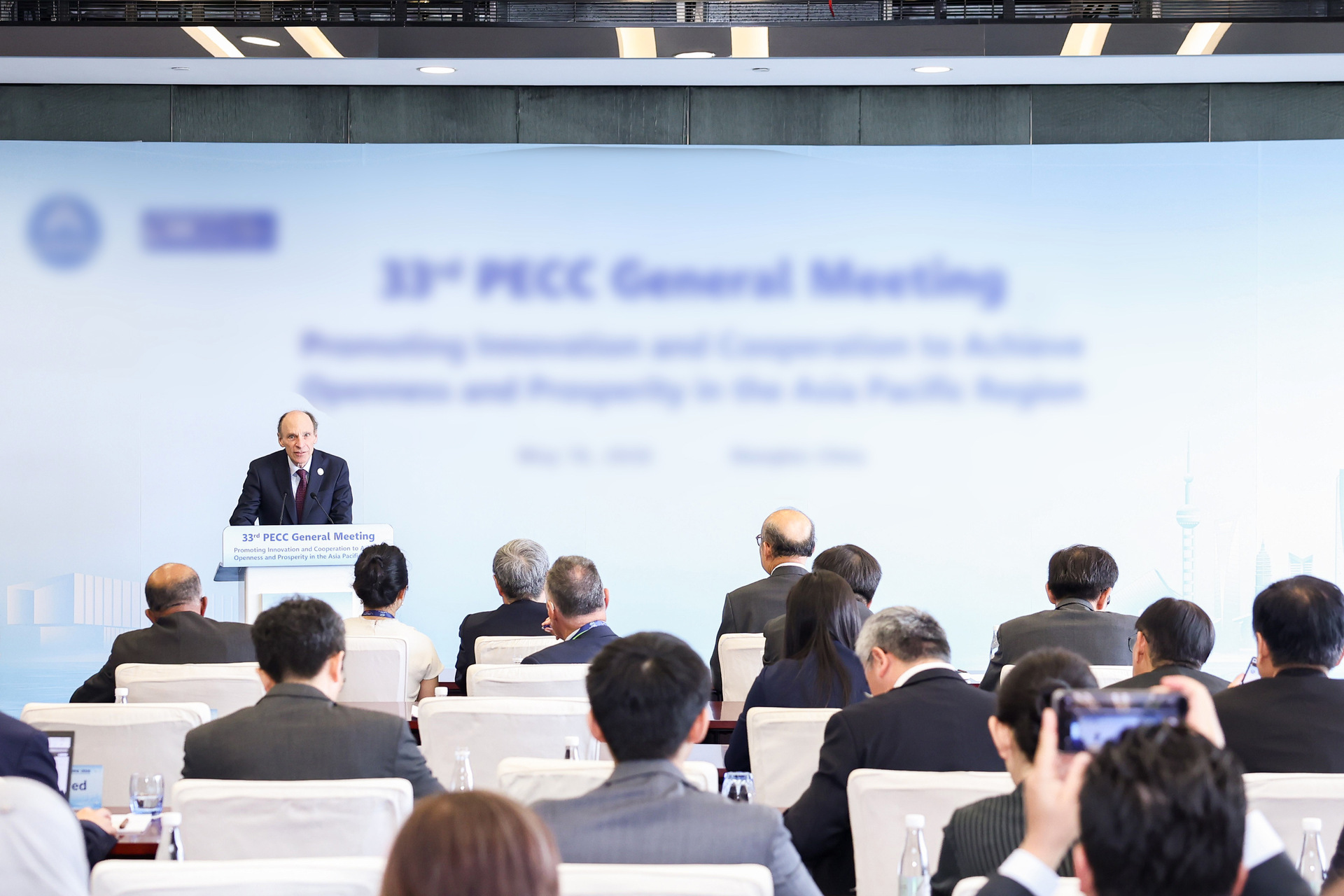
The 33rd PECC General Meeting in Shanghai opened with a strong reaffirmation of the Asia-Pacific’s commitment to openness, innovation, and deeper regional cooperation at a time of heightened geopolitical and economic uncertainty.
In his welcome remarks, Ambassador Zhan Yongxin, Co-Chair of PECC and Chair of China National Committee for Pacific Economic Cooperation (CNCPEC), emphasized that innovation has become “the core driving force” for future growth, while openness and inclusive cooperation remain “the inevitable path for common prosperity.” He encouraged participants to use the PECC platform to exchange ideas, deepen mutual understanding, and explore new pathways for regional collaboration.
Delivering the keynote address, Mr. Huang Mengfu, Former Vice Chair of the National Committee of Chinese People’s Political Consultative Conference (CPPCC) and Honorary Chair of China National Committee for CNCPEC, reinforced the importance of innovation and openness as foundations for sustainable regional development. He further emphasized the need to advance an Asia-Pacific Community grounded in multilateralism and shared prosperity, warning that rising protectionism and economic fragmentation could undermine regional stability and long-term growth.
In his opening speech, Ambassador Chen Xu, APEC 2026 SOM Chair echoed these themes, stating that economies should “work together to further reinforce practical cooperation in various fields and inject stronger momentum into global economic growth.” His remarks underscored the importance of translating shared regional aspirations into tangible outcomes.
The meeting also highlighted growing concerns about the future of international economic cooperation and the evolving role of regional institutions in an increasingly fragmented global order. Addressing these challenges, Dr. Richard Cantor, Co-Chair of PECC, Chair of the United States Committee for Pacific Economic Cooperation (USPECC), and Vice-Chair of Moody’s Ratings raised the question of whether organizations such as APEC and PECC are prepared to assume stronger leadership roles amid rising global fragmentation. He stressed that regional integration, AI adoption, deeper connectivity, harmonized standards, and effective multilateral cooperation will be critical to advancing the vision of a Free Trade Area of the Asia-Pacific (FTAAP) and maintaining APEC’s relevance.
A common theme throughout the discussions was that, despite significant challenges and uncertainties, the Asia-Pacific region has immense potential to drive sustainable development, strengthen multilateral cooperation, accelerate innovation, and enhance connectivity in support of long-term prosperity and stability.
Session I - Deepening Openness: Key Spirit of APEC and Asia Pacific Community
Speakers emphasized that preserving openness and strengthening regional integration are critical amid rising protectionism, supply chain vulnerabilities, energy insecurity, and climate pressures. In this context, connectivity—spanning digital systems, infrastructure, energy networks, and people-to-people exchanges—was consistently identified as a foundational pillar for resilience and long-term growth.
While the energy transition poses distinct challenges, it simultaneously offers unprecedented opportunities to drive regional sustainability, fortify energy security and accelerate green development.
Despite increasing global risks and uncertainties, speakers stressed that platforms such as APEC and PECC remain vital for sustaining cooperation, fostering dialogue and ensuring that regional integration remains inclusive and development oriented.
Session II - Promoting Innovation: Key Driver of Prosperity and Asia Pacific Community
The session highlighted how artificial intelligence is reshaping growth, trade, governance, and competitiveness across the Asia-Pacific, while also presenting risks such as widening inequality, market concentration, and a growing digital divide. Discussions emphasized that the challenge lies not only in how AI transforms economies but also in ensuring its benefits are broadly shared through effective governance, capacity building, digital infrastructure, skills development, and regional cooperation.
In this context, speakers underscored the need for stronger collaboration through APEC, including practical progress on initiatives such as the Free Trade Area of the Asia-Pacific (FTAAP), alongside efforts to advance digital transformation, data governance, connectivity, and business engagement.
Overall, the session reaffirmed a shared commitment to leveraging AI and regional cooperation to promote inclusive, resilient, and sustainable growth across the Asia-Pacific.
Special Session - AUSPECC/CNCPEC Workshop on Regional Trade: Advancing APEC’s FTAAP Vision
The session examined the future of Asia-Pacific economic integration amid rising geopolitical tensions, technological change, and growing pressures on the global trading system. Speakers emphasized the continued importance of open markets, regional dialogue, and cooperation, while acknowledging challenges such as supply chain fragmentation, regulatory complexity, and weakening multilateral institutions.
A central focus was the role of APEC in advancing the vision of the Free Trade Area of the Asia-Pacific (FTAAP). Speakers highlighted the value of practical, incremental approaches—including “pathfinder” initiatives that enable willing economies to pilot new areas of cooperation and build momentum for broader regional adoption.
Speakers identified digital trade, customs modernization, sustainability, AI applications, environmental goods, and regulatory transparency as promising areas for such collaboration. They also emphasized the importance of inclusive integration, stressing that smaller and developing economies should be supported through capacity building, knowledge-sharing, and institutional openness. Recognizing the growing influence of digital transformation, Environmental, Social, and Governance (ESG) requirements, and emerging entrepreneurs, speakers underscored the need for innovation, transparency, and adaptability in shaping the region’s future.
Overall, speakers expressed pragmatic optimism that APEC can continue to serve as a platform for practical cooperation, with pathfinder approaches and sustained dialogue helping to advance regional integration and shared prosperity across the Asia-Pacific.
Concluding Session
In his closing remarks, Ambassador Zhan Yongxin, Co-Chair of PECC and Chair of CNCPEC, emphasized that long-term prosperity will depend on strengthening regional connectivity, accelerating cooperation in the digital economy and artificial intelligence, advancing trade facilitation, and reinforcing support for the WTO-centered multilateral trading system and the long-term development of the Free Trade Area of the Asia-Pacific (FTAAP).
While global uncertainty persists, he noted that “Openness, innovation, and cooperation remain irreversible regional trends.” This message underscored a shared belief that these principles will continue to serve as the foundation for inclusive, resilient, and sustainable growth across the Asia-Pacific region.
(Click here for the meeting program)