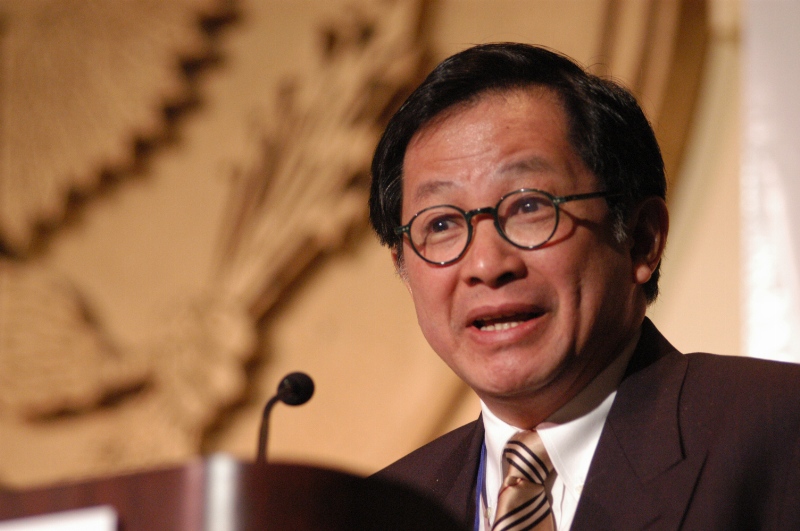
Dr Hadi Soesastro, founding member of PECC, made contributions on many issues in PECC throughout the 30 years.
Opening Statement at the PECC First Meeting “the Pacific Community Seminar”, Australian National University, Canberra, 15-17 September, 1980
Dr Hadi Soesastro:
If we talk about the Pacific Community, what we have in mind is a group of people or nations who share a common objective and agree upon the means by which this objective may be realised. The starting point that most people have used in their analysis relates to the word 'interdependence', and specifically to economic interdependence. This leads me to two major questions. The first relates to the question whether economic interdependence could lead us to agree upon a common objective and on the rules of the game. The second question is whether growing economic interdependence should be supported by a perception of political interdependence. Is there a need for the people in this region or the nations bordering the Pacific to come together and join forces, either to deal with the problems they are facing together in the region or in facing the threat that comes from outside the region?
Let me turn first to the question of economic interdependence and whether it can lead us to agreeing upon a common objective and set of rules of the game. What we have done so far is to observe economic interdependence through statistics. They certainly tell us a lot, but I am not sure if they tell us the whole story of interdependence. We should perhaps examine more closely the structure of this interdependence. I might have quite an ASEAN bias in stating that there may also be a feeling of an uneasy interdependence. There may be some who would like in fact to see that we loosen such interdependence.
Although there is growing economic interaction and trade among all the countries in this region, it has grown faster for some than for others. The share of Japan and the United States in ASEAN's total trade has in fact increased. From an ASEAN viewpoint, there is some uneasiness with regard to the development of such trade relations. Looking at the development in trade between the United States and Japan on the one hand, and East Asia on the other, East Asian countries have generally experienced growing trade surpluses with the United States, but expanding deficits with Japan. There is consequently a problem of asymmetry in this relationship. Such problems faced by Northeast Asian countries like Hong Kong, Taiwan and South Korea are likely to be encountered by ASEAN countries in the future. The same thing is true if we look at problems of investment. United States and Japanese investments have created some problems in the region, and especially in some ASEAN countries. The energy issue faces similar problems. There are some who would like to see the area of energy become a strong starting point for bringing countries together in the region. There is, for example, a suggestion for a Pacific basin energy quadrangle, with ASEAN, Australia and Canada as major regional suppliers of energy, and Japan and the United States as the major regional users. But the resulting pressures that are put to the regional producers of energy might well in fact become a disintegrating factor.
With regard to the problem of political interdependence as support for economic interdependence, the major issue is the relation between the formulation of national economic policies and issues of interdependence. Certainly, economic planners say they welcome the development of economic interaction in this region. But in fact, it is often true that economic planners also have to take into consideration other factors, even in ASEAN countries where governments are considered strong. These considerations include nationalistic views and demands. One such expression is reflected in the North‑South debate. If governments in the developing part of this region can secure better concessions in terms of North‑South negotiations, I think they will be better able to put more policy emphasis on creating a Pacific Community.
There is a belief amongst the developed part of this region that a Pacific Community already exists in spirit if not in form. Even within ASEAN there seems to be some recognition of the longer term need to resolve problems in a multilateral way. But before mechanisms and institutions can develop, it will be necessary to socialise the idea of Pacific co‑operation. Economic interdependence is important, but it is not sufficient. More communication and contact among the people of the Pacific is one useful beginning.
Below are links to his more recent papers presented in PECC :